
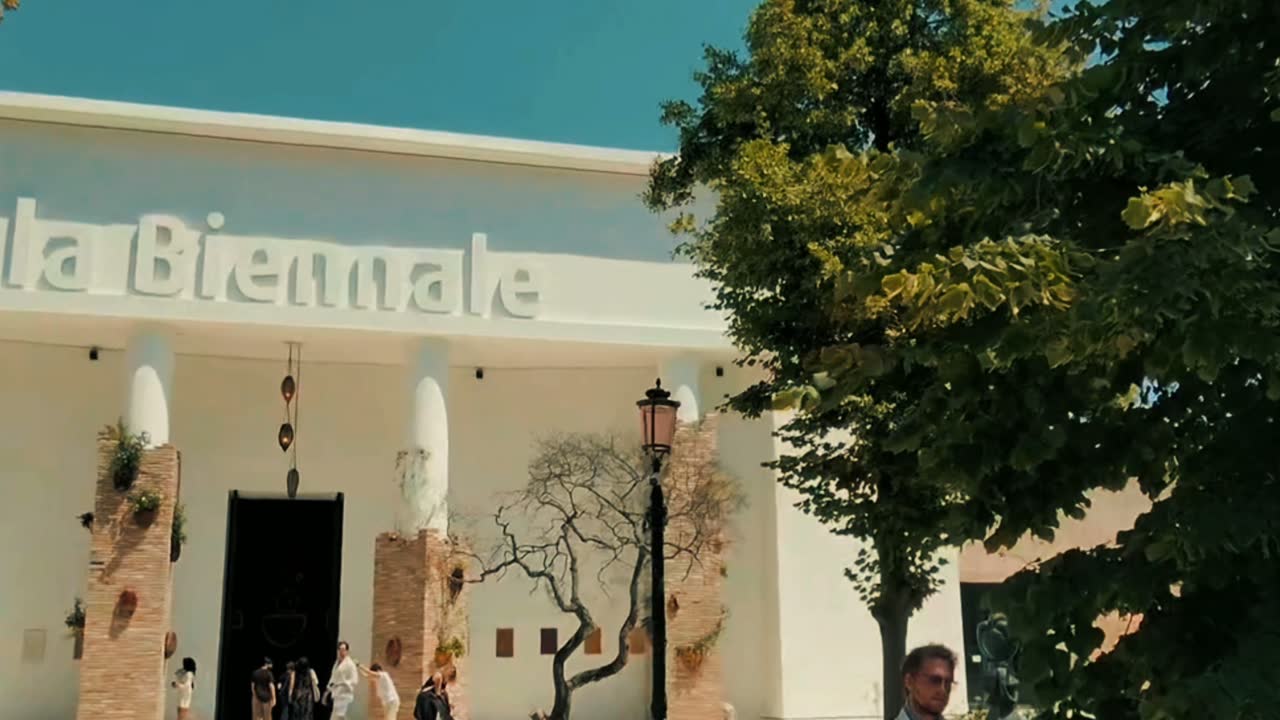
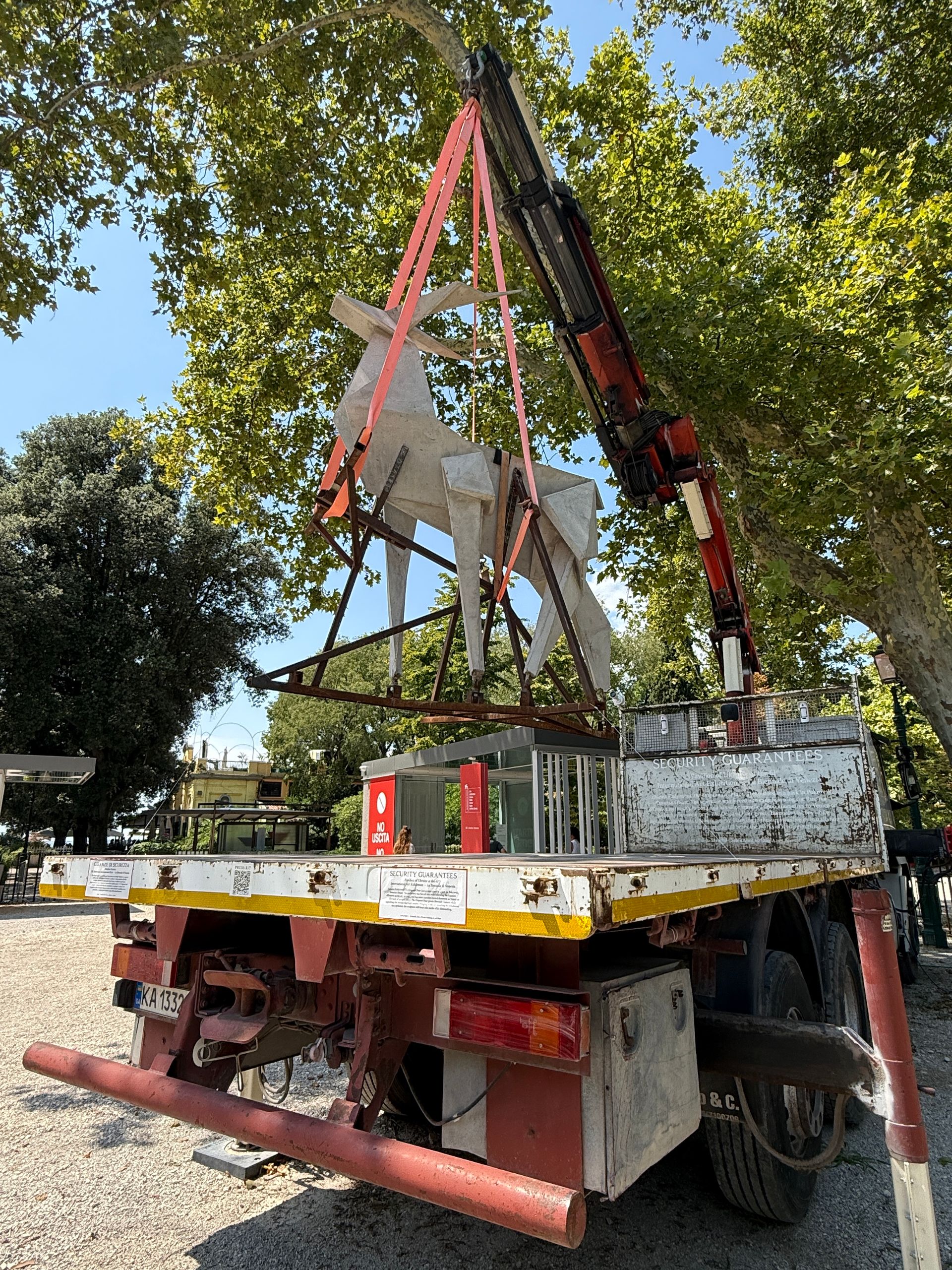
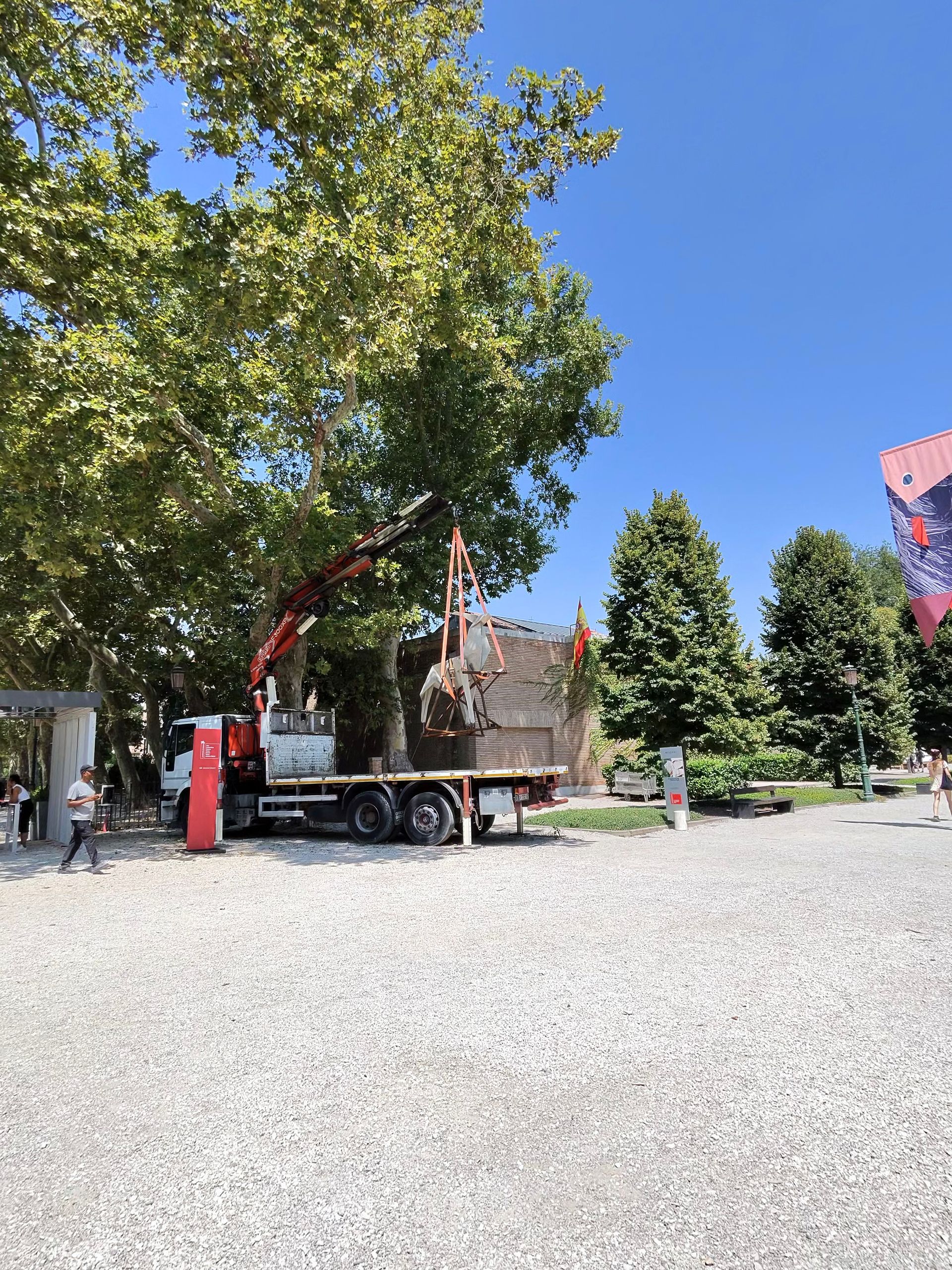

I saw the first artwork before I had shown my ticket. Above the heads of the queue at the entrance to the Giardini, a concrete animal in an orange harness hung from a crane — lifted off the ground, as if it had just landed or was about to be taken away. I remembered it as a unicorn. The label, which I went back to weeks later, is merciless to my memory: this is "The Origami Deer" by Zhanna Kadyrova, a stag with angular flanks that look folded out of paper. In 2019 the artist installed it in a park in Pokrovsk, on the spot where a Soviet jet capable of carrying nuclear weapons once stood on a plinth. When the front line reached the city in August 2024, the deer went into exile: more than six thousand kilometres on a flatbed truck, across half of Europe, until it came to hang in Venice — "as it awaits installation on its pedestal," the caption says. This year's Ukrainian pavilion is called "Security Guarantees." The ones from the Budapest Memorandum, which, as Kadyrova puts it, were supposed to protect us, but existed only on paper.
That is how the world's oldest biennale greets its guests. And then you open the catalogue of the main exhibition, which begins not with an essay but with an instruction:
[Take a deep breath].
[Exhale].
[Drop your shoulders].
Between that deer and that breath, my whole Venetian summer was meant to be stretched. And this essay will be stretched between them too.
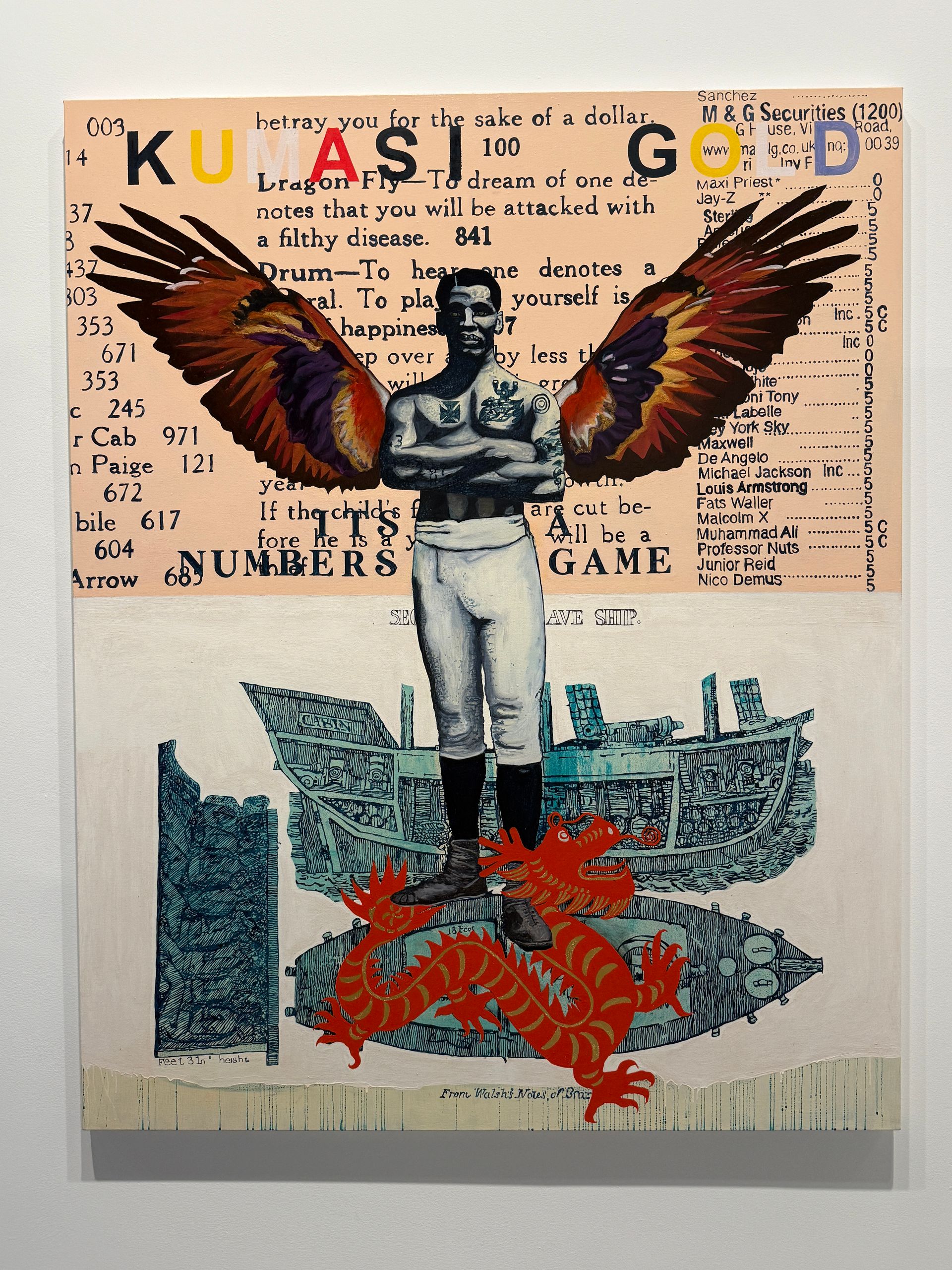
In Venice I remembered a thought that "A Portrait of the Artist as a Young Man" once left with me. Stephen Dedalus, Joyce's precocious student, lectures a friend on his aesthetic theory as they walk through Dublin: the feelings stirred by improper art are kinetic — desire or loathing. Desire urges us to possess, to go towards something; loathing urges us to abandon, to walk away. The arts that play on them — the pornographic and the didactic — are therefore improper arts. Aesthetic emotion, by contrast, is static: "the mind is arrested and raised above desire and loathing."
Arrested. Joseph Campbell called this state aesthetic arrest. In English as in Polish, it sounds almost medical, like cardiac arrest. And rightly so: Joyce himself writes of a "cardiac condition" that the physiologist Luigi Galvani called "the enchantment of the heart." Campbell supplied the modern footnotes: advertising is simply pornographic art, because it stirs desire; commentary in art is didactics, because it stirs loathing and demands action. Proper art does something else: it takes a fragment of the world into a frame and lets you see it as one thing — the rhythm of part to part and of part to whole — "and when a fortunate rhythm has been struck by the artist, there is a radiance. That's the epiphany." Joyce translated it as wholeness, harmony and radiance; Campbell understood it as the moment when the absolute shines through a thing. A religious person will say: the face of God. A non-religious one: the instant when the world stops being a tool.
The thought of Joyce and Campbell turned into a question of mine: on an exhibition where everything today is politics — passports, protests, grants, resignations — can the arrest still happen? Can the art of the most didactic of decades still bring about a state in which you want nothing at all?
To get ahead of the facts, the honest answer is: yes, it happened to me many times. And almost never where I expected it.
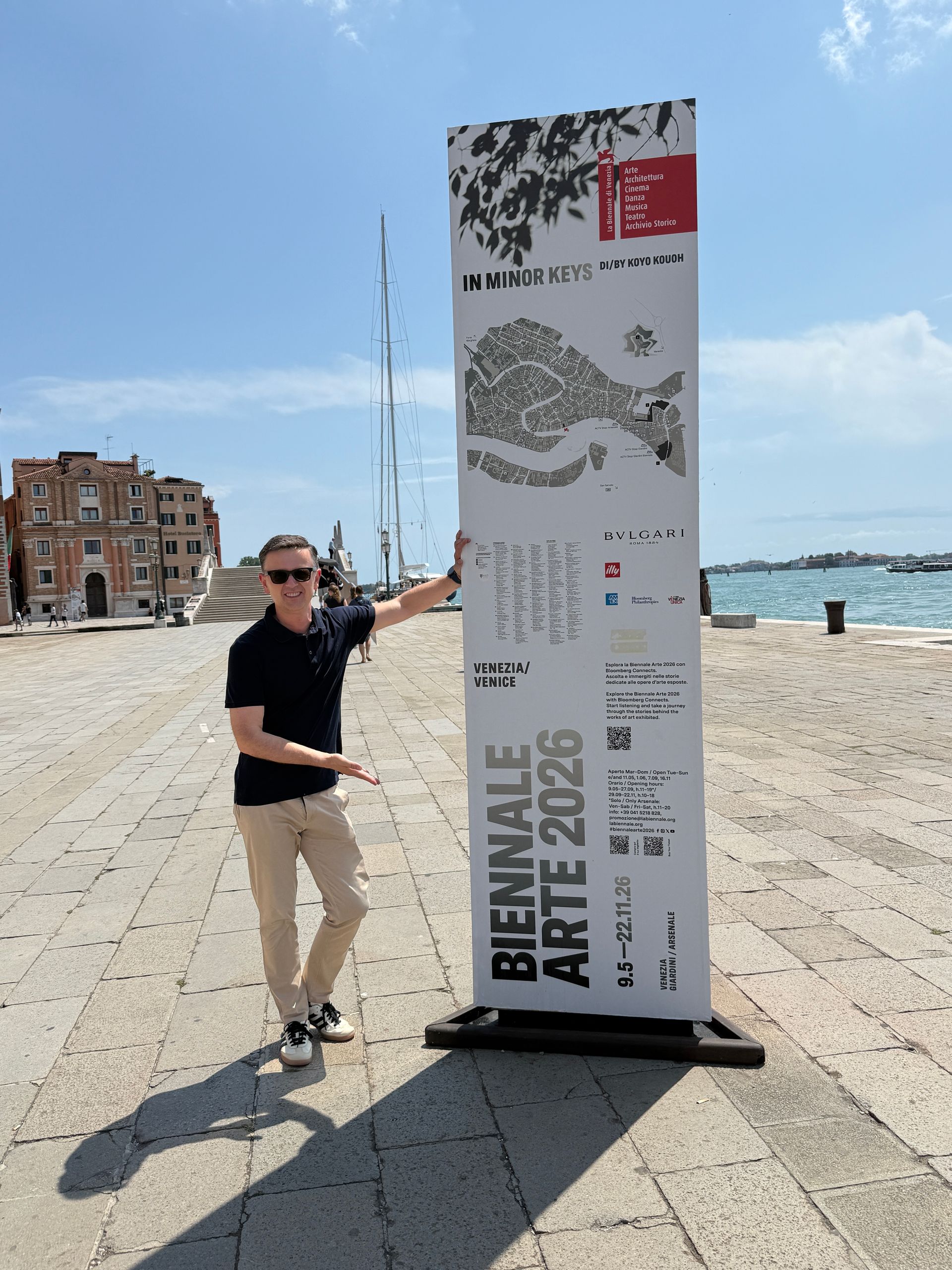


First, the scale, because the scale is part of the experience. A hundred and ten participants in the main exhibition; a hundred national participations; thirty-one official collateral events; seven countries making their debut, Qatar, Vietnam and Sierra Leone among them. The press has long called the Biennale "the Olympics of the art world," and for most of the walk the metaphor seems perfectly innocent.
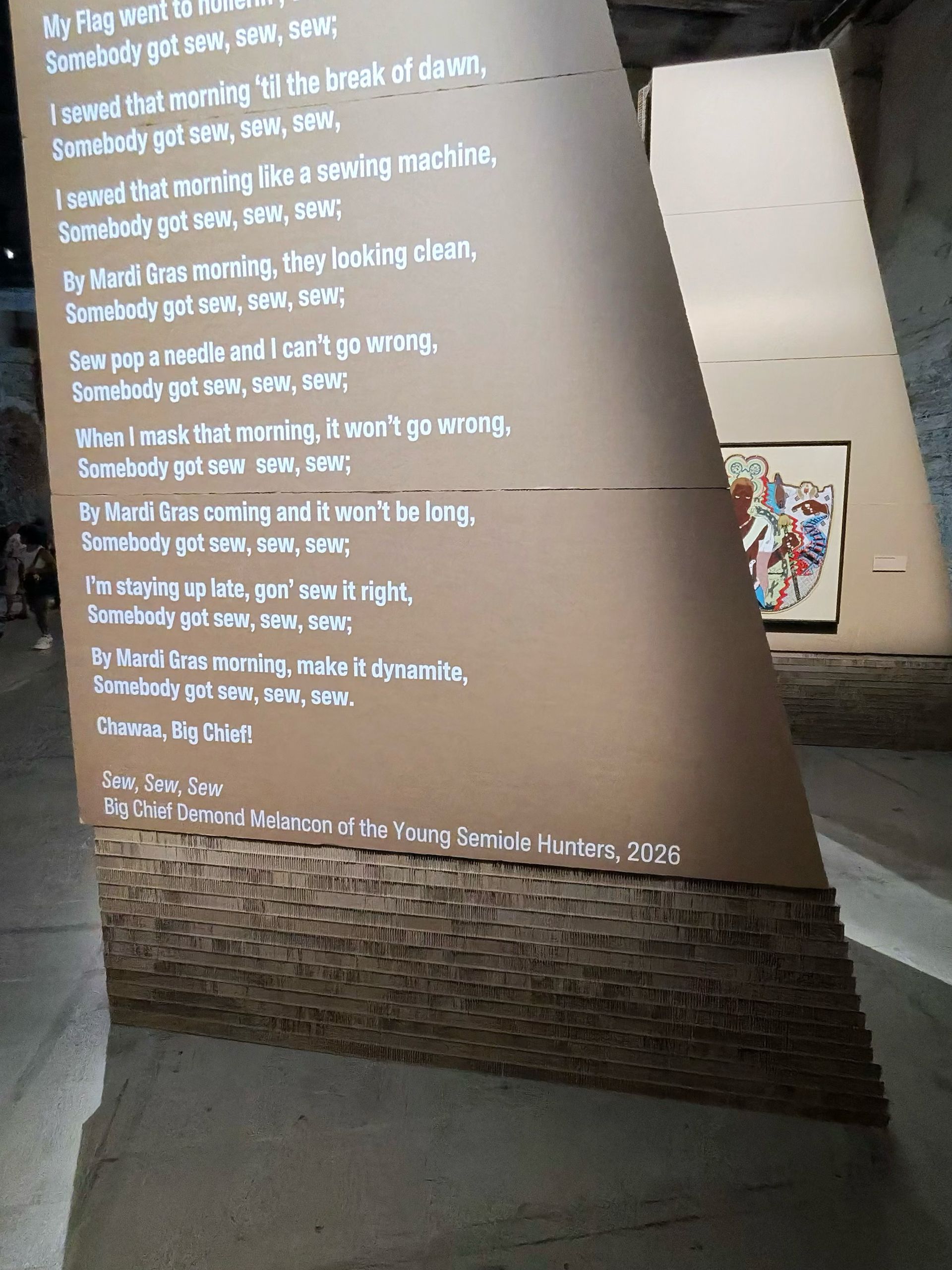
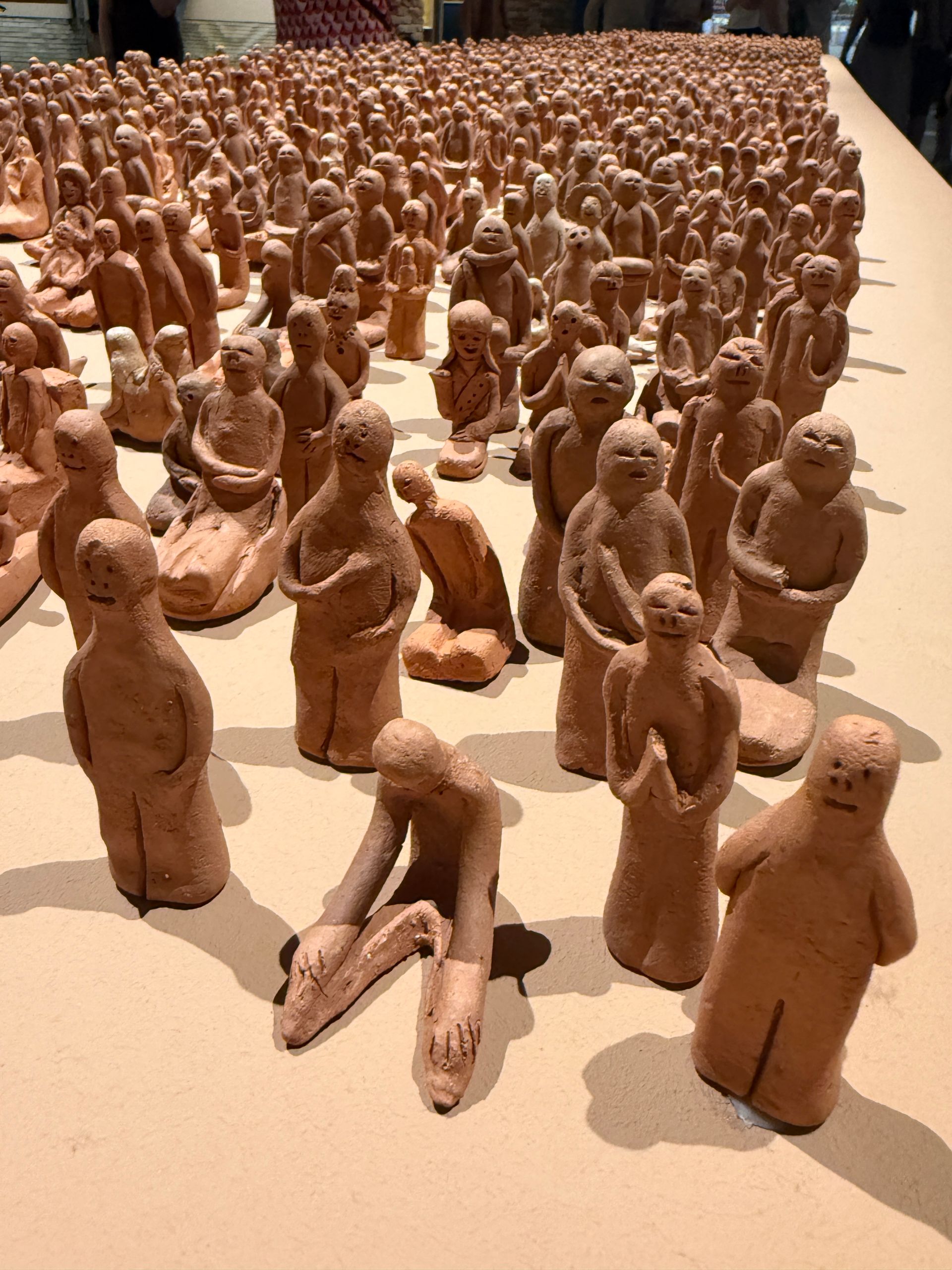


In a single afternoon at the Arsenale you pass from the sewing song of Big Chief Demond Melancon of New Orleans — "Somebody got sew, sew, sew," suits of beadwork worn by the Mardi Gras Indians — to the vessels of Adebunmi Gbadebo, shaped from the soil of the burial ground of the True Blue plantation in South Carolina, with human hair and Carolina Gold rice worked into the clay; from the two and a half thousand clay figurines that the Burmese painter Sawangwongse Yawnghwe has set marching in a six-metre exodus, to the Haitian lwa spirits that Edouard Duval-Carrié has cast in bronze — for what does a nation take along when it flees across the sea? Its spirits, of course. Further on, the painted kené patterns of Sara Flores of the Shipibo-Konibo people of the Peruvian Amazon, and the Uzbek pavilion, where the dried-up Aral Sea tells its own myth in the voices of salt, shells and enzymes. In the Saudi pavilion lie 29,221 clay bricks by Dana Awartani, hand-laid into the mosaic patterns of monuments destroyed or endangered — the list on the wall runs from the churches of Aleppo, through the palace of Beiteddine, to the monastery of Saint Hilarion in Gaza; the bricks are made without mortar and will slowly crack, because heritage cracks. "Stones are never neutral," the artist writes, "especially when in ruins."
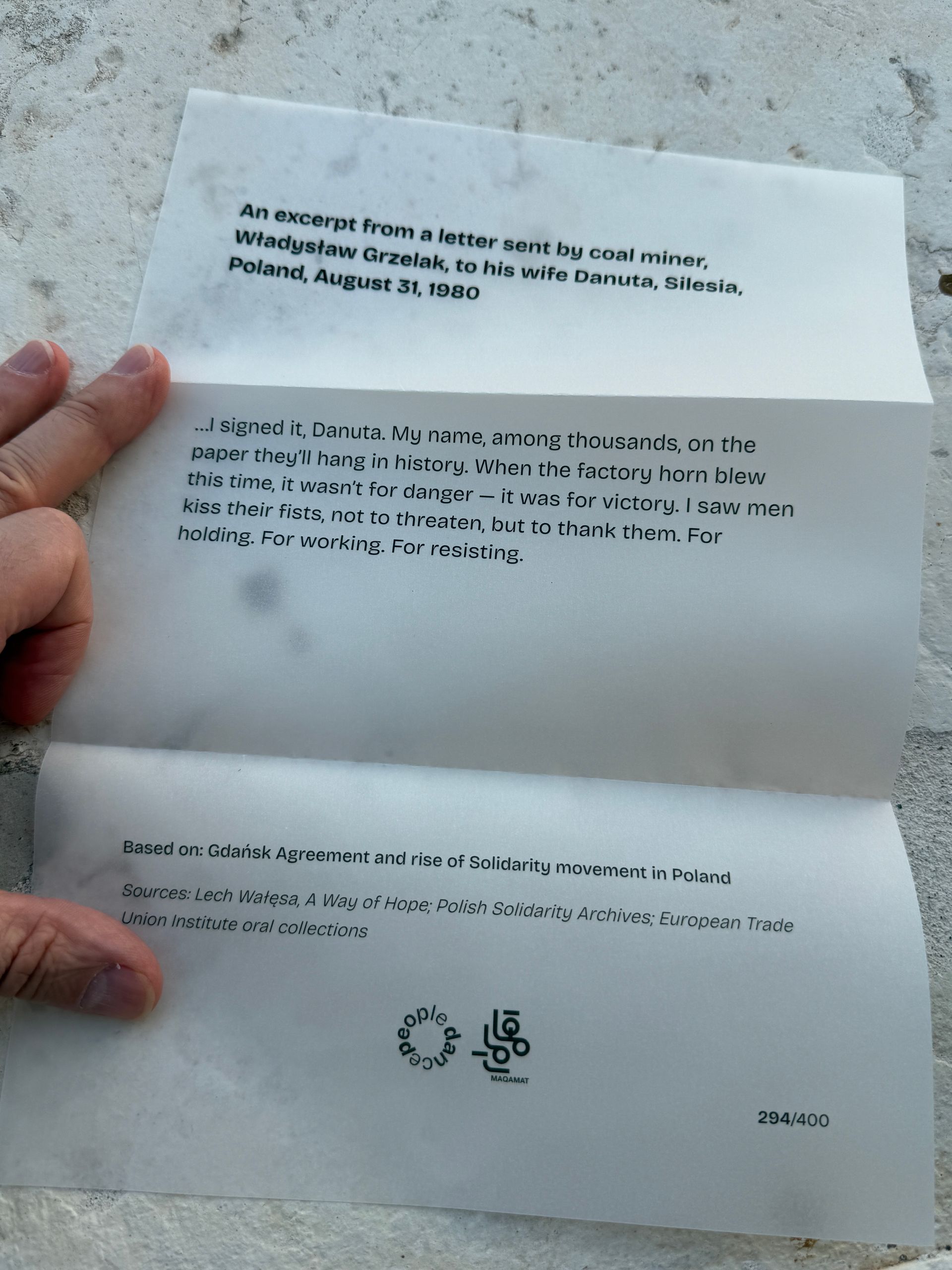
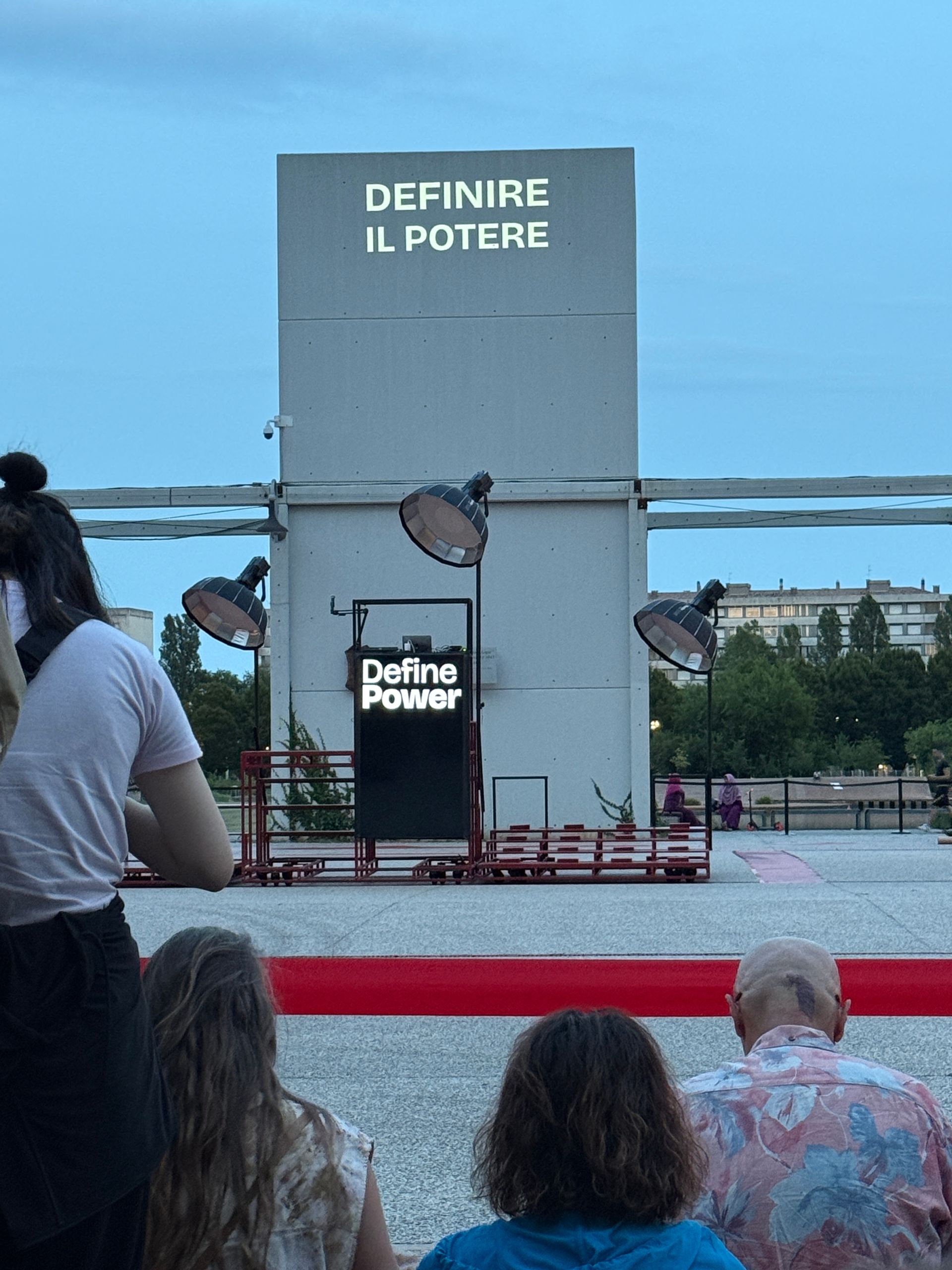
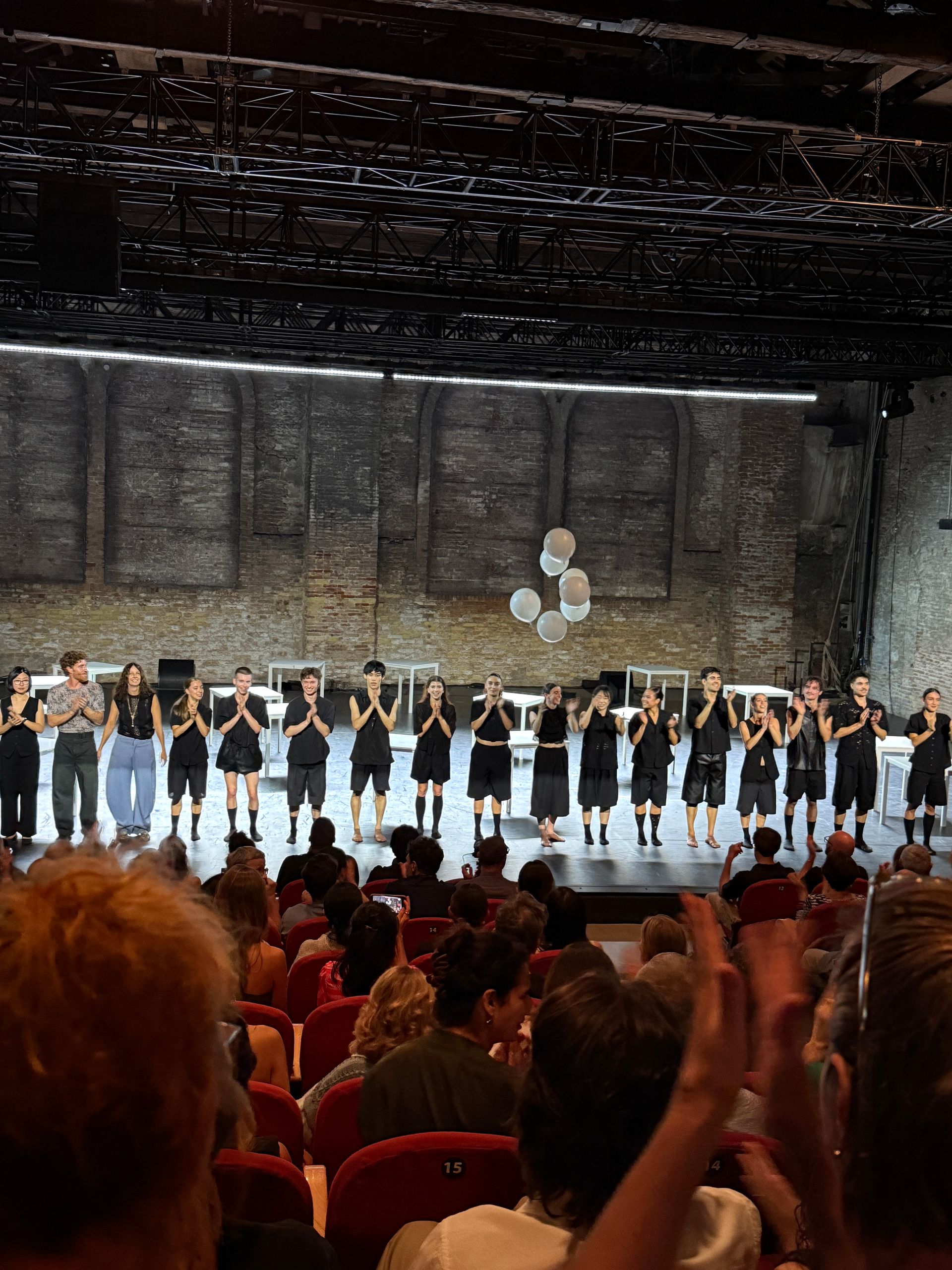

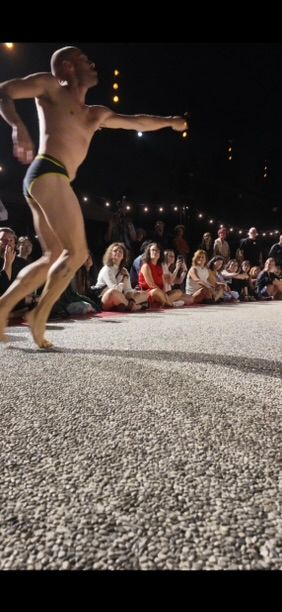
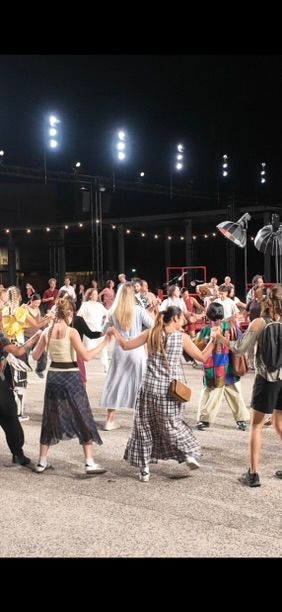
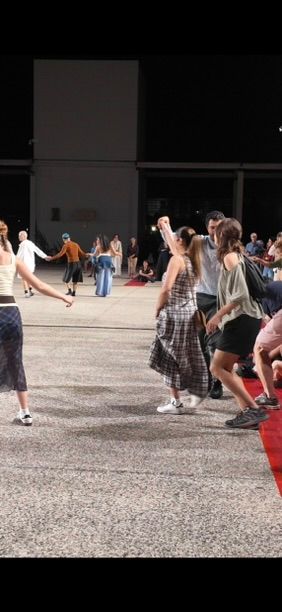
This globality spills beyond the art exhibition itself. The Biennale Danza was running in parallel, and its Golden Lion went to Australia's Bangarra Dance Theatre, whose dance grows out of the culture of Aboriginal Australians, sixty-five thousand years old — the oldest continuous culture on earth on the stages of the world's newest art. And on a square in Mestre, before his performance "Dance People," the Lebanese choreographer Omar Rajeh handed out numbered sheets of paper; mine carried a Silesian miner's letter to his wife from August 1980: "I signed it, Danuta. My name, among thousands, on the paper they'll hang in history." The world really does meet here — sometimes in order to hand us back our own history in a version we had forgotten was universal.
And yet the sense of true globality comes not from the number of flags but from the opposite: from the fact that this year almost nobody here is shouting. Koyo Kouoh, the first African woman to curate the Biennale, died suddenly in May 2025, just before the title of the exhibition was to be announced. She had had time to define everything: the theoretical frame, the list of artists, the catalogue, the architecture of the show. Her team finished the work without her — which makes this edition, in passing, an exhibition about fidelity to someone else's vision. The title is "In Minor Keys." "In refusing the spectacle of horror," Kouoh wrote, "the time has come to listen to the minor keys, to tune in sotto voce." No Golden Lions for lifetime achievement were awarded this year at all; she had not lived to name them, and nobody dared to name them in her place.
After decades in which the great exhibitions tried to outshout one another, the motto of the greatest of them all turned out to be — of all things — quiet.


Poland has a house of its own in all this commotion. Literally.
We could have had one earlier, and cheaper. In 1920 Venice offered the young Polish Republic the abandoned German pavilion for a hundred and fifty thousand lire; the chance was lost through what the records call the culpable sluggishness of officialdom. The subject returned in the late twenties thanks to the art historian Mieczysław Treter and the TOSSPO society, which promoted Polish art abroad under the patronage of the Foreign Ministry. The government approved the project in 1931, and at the 18th Biennale, in 1932, the pavilion opened. It stands on the island of Sant'Elena, as a wing of the complex designed by Brenno Del Giudice. The Biennale decided what the building would look like, but Poland paid for it (the construction was to cost no more than two hundred thousand lire, roughly a hundred thousand złoty of the day), becoming in 1932 the owner of the pavilion — with two caveats: the land beneath the whole of the Giardini belongs to the city of Venice, and the building, under heritage protection since 1998, may be neither demolished nor rebuilt. The Zachęta gallery looks after the exhibitions, an open competition selects the projects, and the Ministry of Culture pays the bills.
There are about thirty owners like us in the Giardini: the pavilions belong to states, the ground to the city. Russia has had its own since 1914, earlier than Poland. It was designed by Alexey Shchusev, later the architect of Lenin's mausoleum. The 1914 catalogue names, as patron and initiator of Russia's participation, the Kyiv industrialist and collector Bohdan Khanenko — on which Ukrainians today rest their argument that the empire's pavilion ought to change hands. Israel built its own in 1952, to a design by Ze'ev Rechter: a white modernist block right next to the pavilion of the United States. The American one is the oddest of them all. It was built in 1930 by a private gallery, and since 1986 it has belonged to the Guggenheim Foundation — so the USA is represented in Venice by a private foundation. The club had long seemed closed, and yet the city can still make the gesture: Qatar has just been granted the first new pavilion in the Giardini since Korea's in 1995, designed by Lina Ghotmeh. The rest of the world rents halls in the Arsenale, palazzi or warehouses — for a single edition, at prices most countries prefer not to disclose.
This little parcel of ours delights me in a peculiar way — not as real estate, but as a bet our forebears placed in 1932: that we would need art every two years for the next hundred. What delights me even more is that Polishness here does not end at the pavilion. On St Mark's Square itself, in the Procuratie Vecchie, the Starak Family Foundation is showing — as an official collateral event of the Biennale — "Tadeusz Kantor (1915–1990). Emballage, Cricotage and Madame Jarema": more than sixty works, from Art Informel through the emballages to the final cycles "Nothing Further" and "I'm Falling, Dammit," together with the original mannequins from "The Dead Class" and Andrzej Wajda's film of the performance, and beside them the monotypes of Maria Jarema and her costumes for "The Cuttlefish" and "The Circus" — the two artists shown together in Venice for the first time in decades. You walk in from the most famous square in Europe, out of the pigeons and the café orchestras, straight into a Cracow darkness; admission is free. In the Albanian pavilion the curator is Małgorzata Ludwisiak; at the Biennale College Danza, Julia Bentkowska and Julia Litwin are dancing; in Rajeh's piece, a letter from Gdańsk is playing its part. Polishness dissolved in the global like salt in water — which is, I suspect, exactly what they had in mind ninety-four years ago.
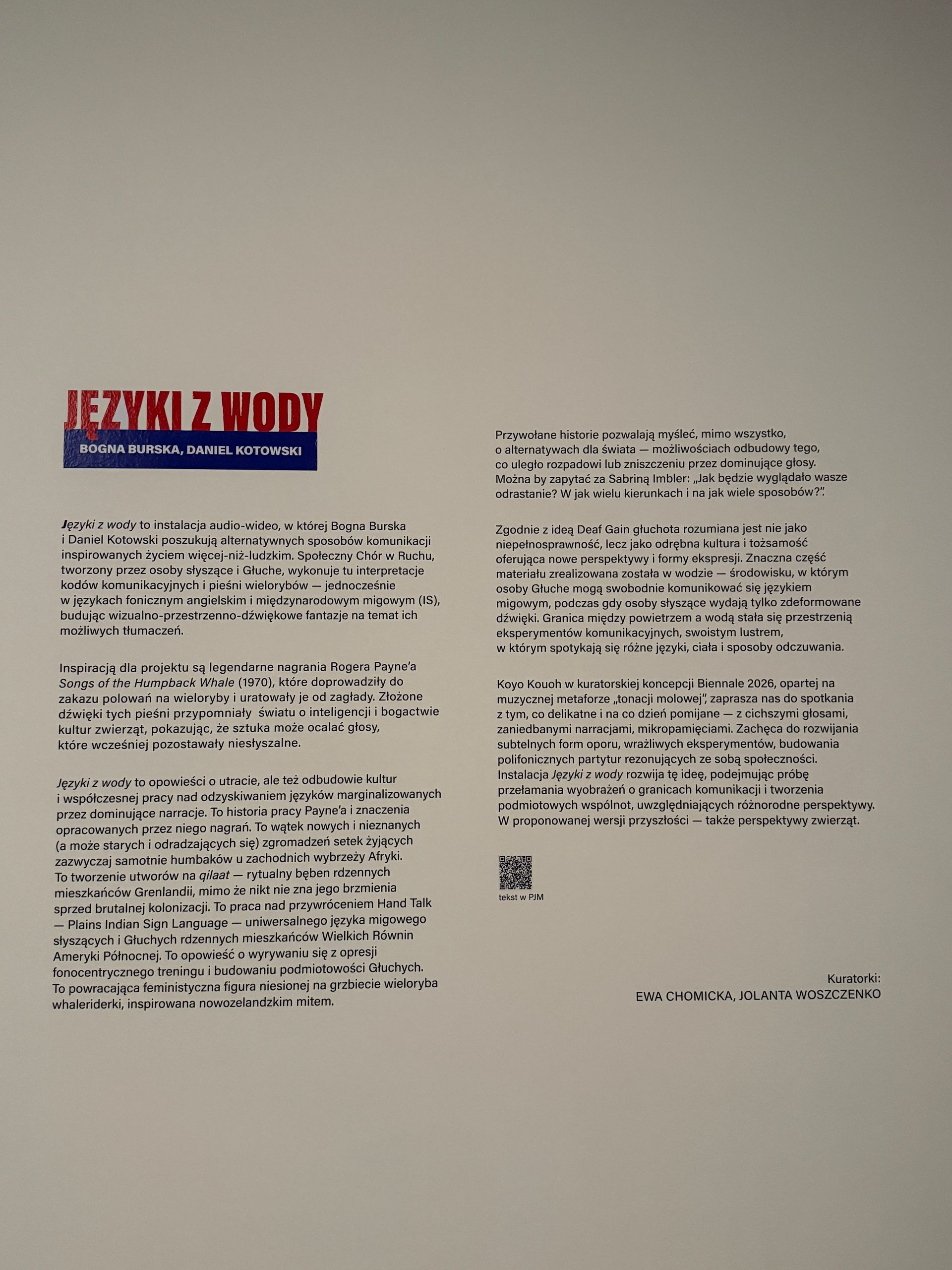
And the pavilion itself? This year it presents "Liquid Tongues" by Bogna Burska and Daniel Kotowski, curated by Ewa Chomicka and Jolanta Woszczenko: on huge screens, a submerged choir of hearing and Deaf performers interprets the songs of humpback whales from Roger Payne's legendary recordings, in voice and in sign at once. Hair drifts like seaweed, hands speak, the low frequencies register in your breastbone — which is exactly how Deaf people perceive sound. Underwater the hierarchy flips: the signers are at home, and the hearing can only gurgle. It is hard to imagine a work more faithful to the minor keys — a language that is neither human, nor phonic, nor a majority's, and yet is a language. I lay beneath that screen for a long time and wanted nothing.


And now the politics, because this year there was no avoiding it even by accident.
Russia returned to its pavilion for the first time since 2022, when its curator and artists walked out, calling the war unbearable. It returned with an exhibition titled "The Tree is Rooted in the Sky" — and on special terms: after a wave of protests, the public was admitted only on the preview days; then the doors were locked, and recorded performances played on screens outside. Pussy Riot and FEMEN protested at the pavilion, twenty-two European culture ministers wrote letters, and in July the European Commission withdrew a two-million-euro grant from the Biennale. What remained was a building turned television: Russia present and absent at once.


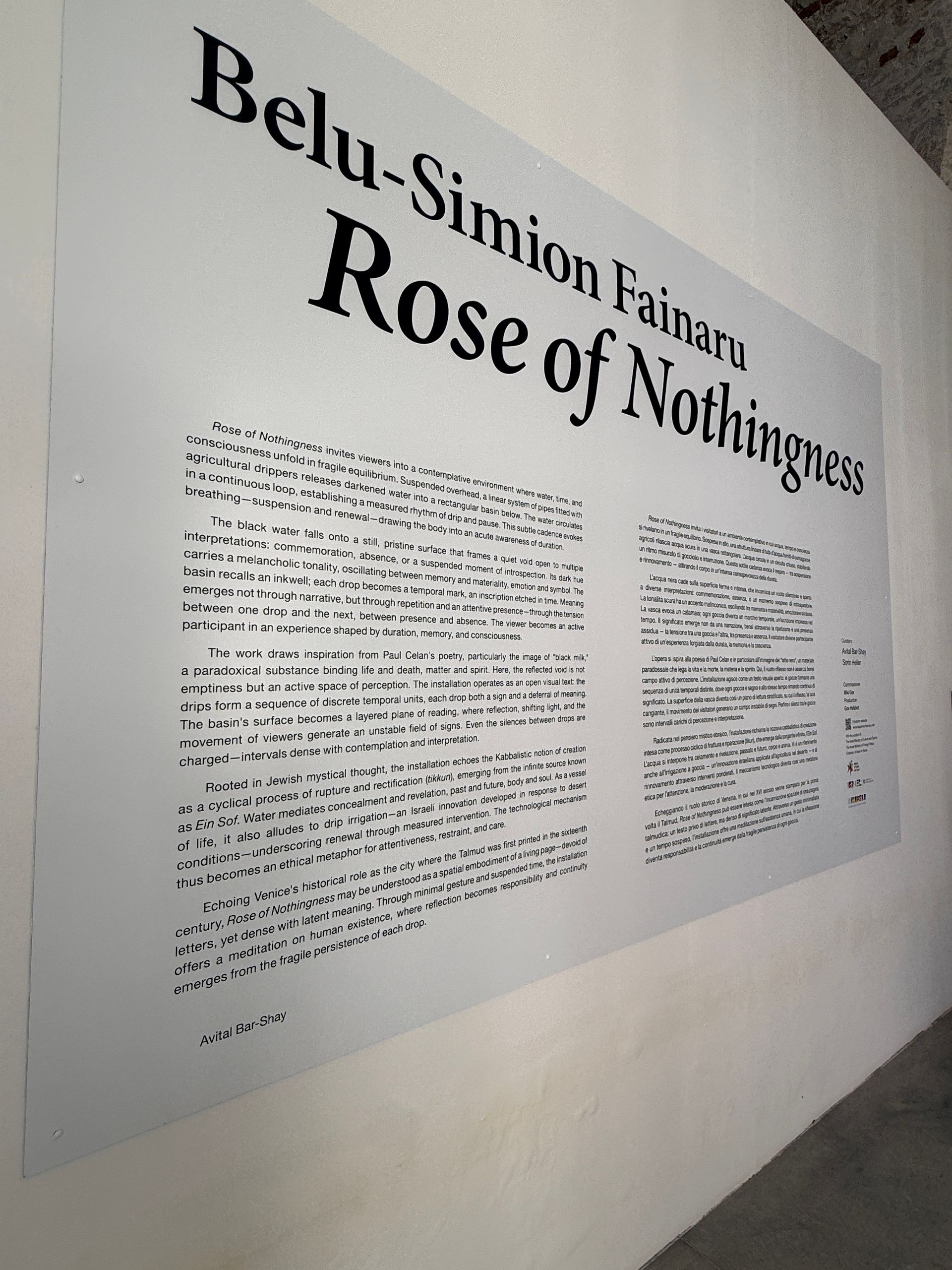
Israel takes part formally, but not at home: its Giardini pavilion is under renovation, so the national presentation moved to a rented space in the Arsenale. There Belu-Simion Fainaru, a sculptor born in Bucharest and living in Haifa, shows "Rose of Nothingness": a ceiling-hung lattice of pipes fitted with agricultural drippers feeds black water into a rectangular basin — the black milk of Celan's "Death Fugue," the kabbalistic nothingness of Ein Sof and, as the wall text adds, the Israeli invention of drip irrigation, all in one. And by the entrance, in the most ordinary of freezers, a single black rose sits sealed in a block of ice: impossible to hand to anyone and impossible to wilt. During the opening, two thousand people protested outside the door. Fainaru kept telling journalists that he does not believe in cultural boycotts: "The audience is here for the art."
All around, the machinery of the dispute rattled on. The Art Not Genocide Alliance letter demanding Israel's removal was signed by some two hundred Biennale participants; a separate letter from more than seventy artists and curators of the main exhibition itself went further, demanding the exclusion of Russia and the United States as well: "allowing governments that are actively committing war crimes to participate is not neutrality." Among its signatories were the Palestinian Vera Tamari and Gaza-born Mohammed Joha — both in the main show — and the Israeli artist Hagar Ophir. On the eighth of May, the day before the opening, twenty-seven of the hundred pavilions closed for twenty-four hours in a cultural strike, and three and a half thousand people marched through Venice — the largest protest in the institution's history. In April the awards jury announced that it would not consider pavilions of countries whose leaders are under International Criminal Court arrest warrants — in practice, Russia and Israel — and then, facing legal threats, resigned in its entirety nine days before the vernissage. The Biennale solved the problem in its own way: this year the pavilion prizes will be decided by a public vote, with the results announced on closing day. By accident, it is the most Joycean ruling in the institution's history — the winner will be chosen by an accumulation of quiet delights, not by a protocol.



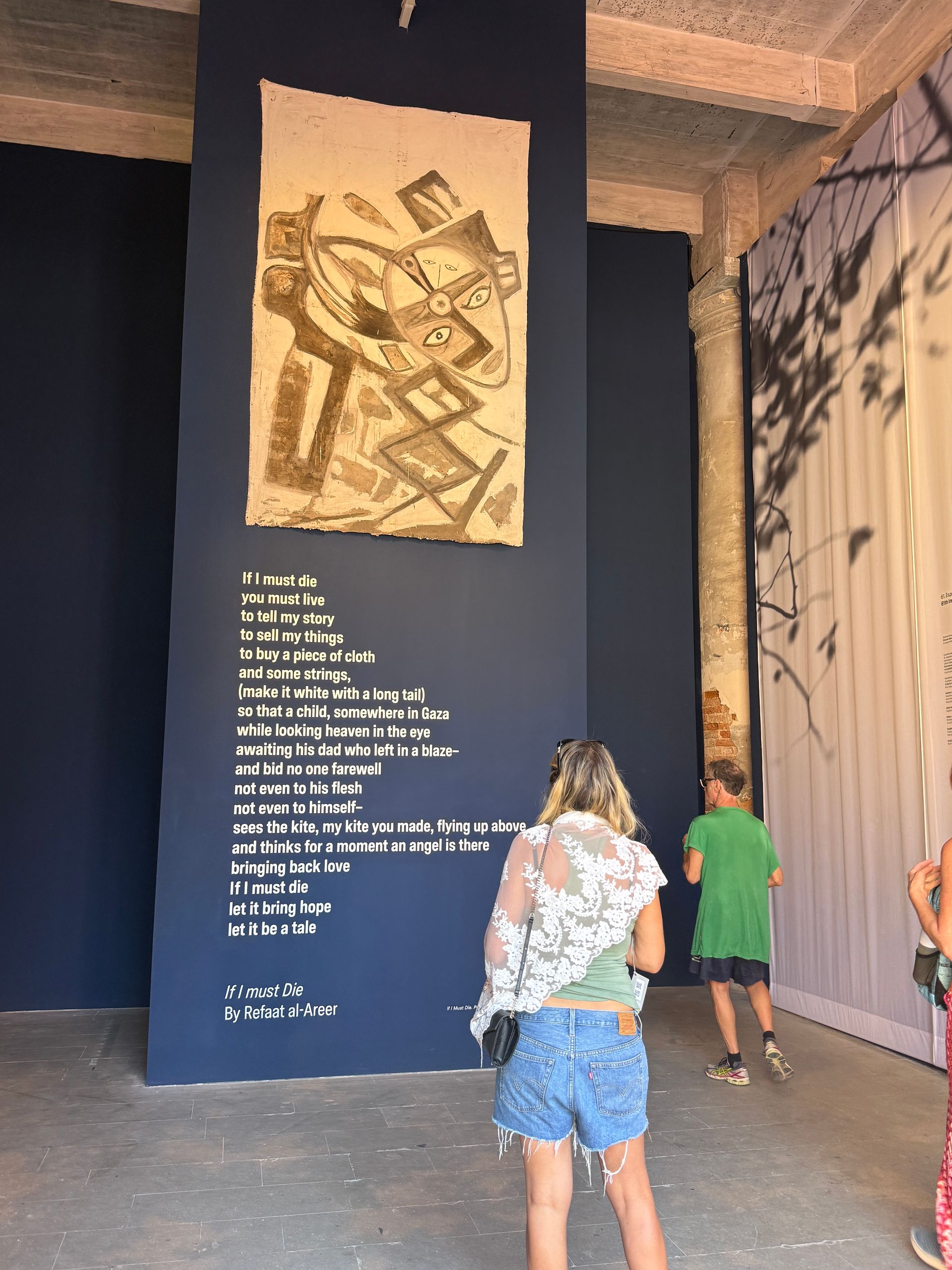
The Biennale's president, Pietrangelo Buttafuoco, defended the open-door principle: were the institution to start choosing "not works but affiliations; not visions but passports," it would cease to be the place where the world meets. A fine sentence — except that the same principle, under which any state recognised by Italy may take part, means that Palestine has no pavilion and never has had. Gaza, meanwhile, is present at the very heart of the main exhibition — not as a state, but as a wound. Those entering the Arsenale are met by a poem by Refaat Alareer, the poet killed in an Israeli airstrike in December 2023: "If I must die, / you must live / to tell my story" — and further on, the kite with a long white tail in which a child somewhere in Gaza will glimpse, for a moment, an angel. A little further hang Joha's collages from the series "No Shelter," glued together from cardboard, fabric and plastic — the very materials from which shelters in Gaza are patched together today. And the Israeli filmmaker Avi Mograbi sets a 1938 business directory of the Levant — Muslims, Christians and Jews interleaved alphabetically — against the Gaza Yellow Pages of 2023: a scrolling list of doctors' offices that existed not long ago. "To seek the minor key in the midst of destruction," Mograbi says, "is not a simple challenge, but a political decision."
And this may be the strangest image of the year: Fainaru's black rose freezing a few dozen metres from Alareer's poem. No curator designed it — Israel ended up in the Arsenale because its pavilion is under renovation; the adjacency is a fact of space, not a gesture. And yet space accomplished what diplomacy could not: it set them side by side, on either side of the same brick.


So do exclusions make sense? Sport — with which the Biennale has more in common than either side would care to admit: national teams, medals, flags, the rhythm of great gatherings — went through all of this first. Apartheid South Africa was shown the door at the Biennale in 1968 (it returned in 1993); it had dropped out of the Olympics in 1964, was formally expelled from the IOC in 1970 and from FIFA in 1976. Post-war Germany was simply not invited to the Biennale in 1948 — its pavilion was hung that year with French Impressionists, perhaps the most elegant punishment in the history of curating — and returned in 1950. In 1974 the Biennale suspended its ordinary edition and devoted itself entirely to Chile after Pinochet's coup. FIFA and UEFA suspended Russia in February 2022; only fifteen "Individual Neutral Athletes" travelled to Paris in 2024 on its passport, with no flag, no anthem, no place in the medal table. This year Venice added a new figure to that catalogue: a pavilion open for three days, then broadcasting itself through the glass. A suspended participant. Competing, but not existing.
The sense of exclusions is probably the same as in sport: they topple no regimes and rescue no victims, but they mark the boundary of a community. They say: what you are doing has ceased to be the internal affair of your passport. The senselessness is the same too: the ricochet hits artists, not ministers, and an institution that once starts sorting passports will have to do it forever, against an ever longer queue of guilt. Why these and not those? Joyce would add a third doubt: exclusion is a perfectly kinetic gesture — it turns the exhibition into didactics before anyone has had time to paint anything. But there is a fourth side as well: Kadyrova's deer is didactic too, after all. It hangs from its crane so that I should want something — the end of the war — and be repelled by something. And yet it stopped me for a moment before I had read the label. So perhaps the line is simpler than I thought: great political art is art first and politics second. Everything else is journalism on an easel.
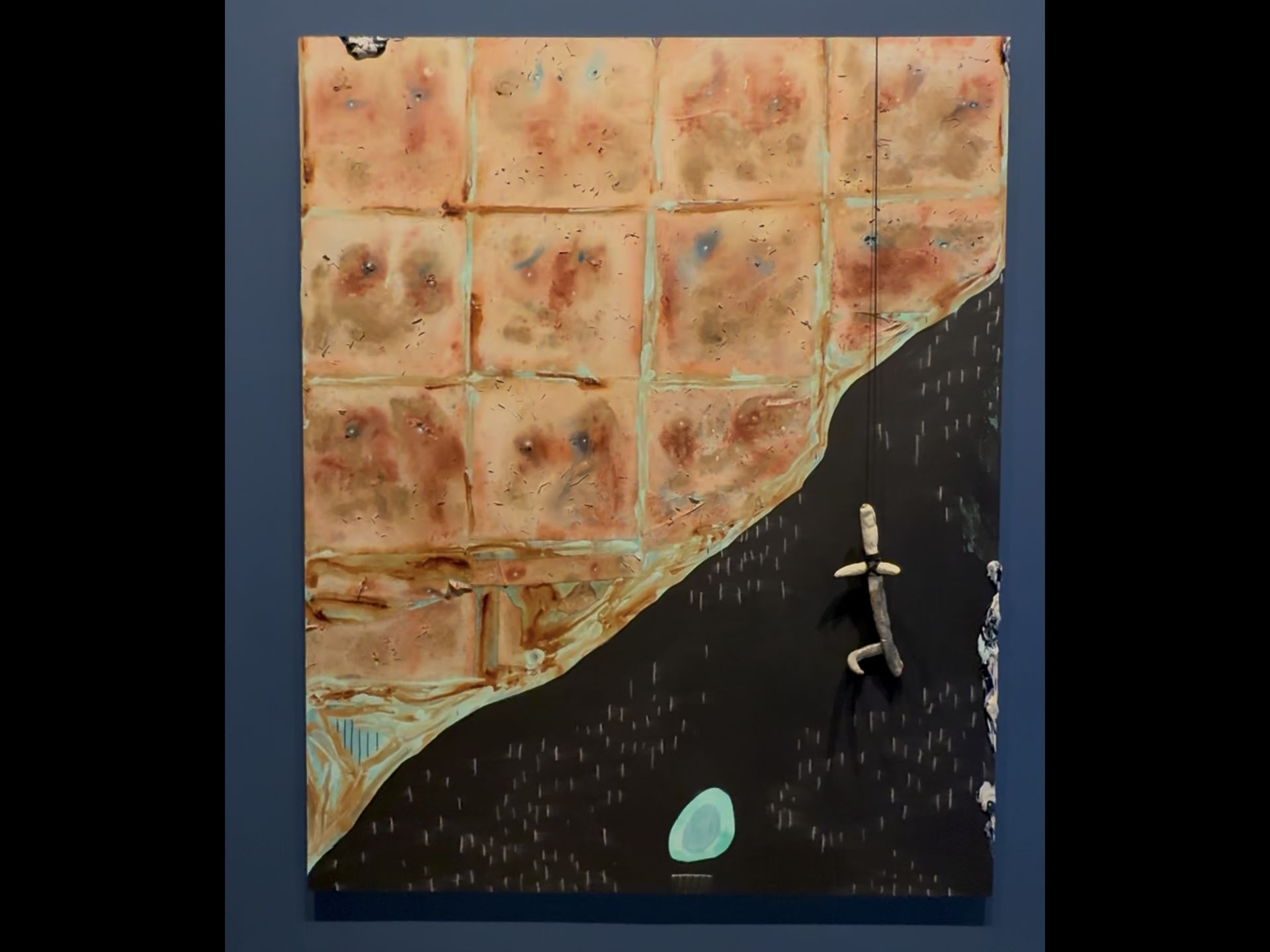

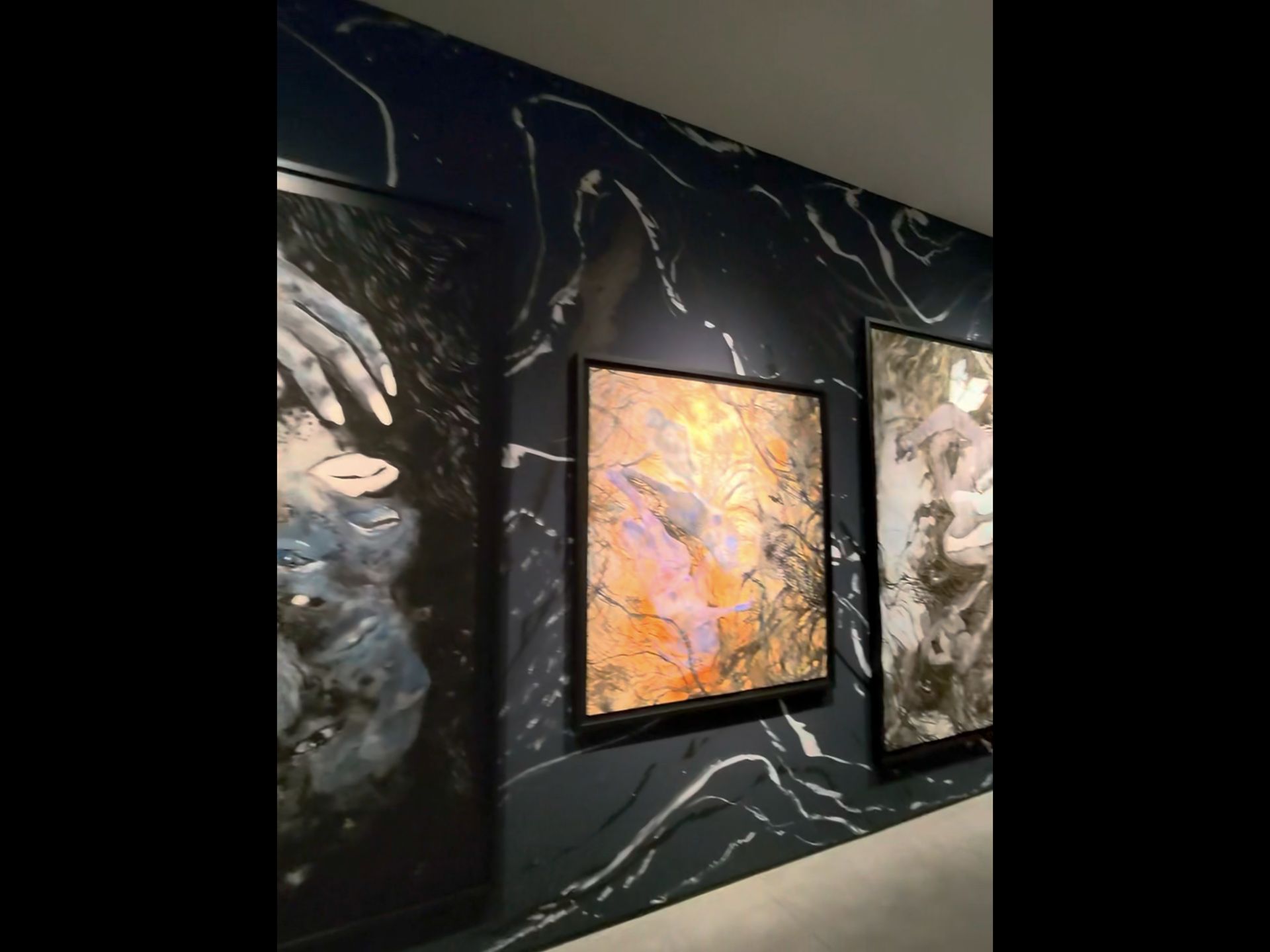
The strongest evidence hangs not in the pavilions but in the main exhibition itself. Manuel Mathieu — born in Port-au-Prince just after the fall of the Duvalier dictatorship, in Montreal since the age of nineteen — shows, among others, the canvases "In the Heart of the Revolution 2" (2025) and "Genocide" (2026). Titles straight off a banner, but there is nothing of the poster in the paintings: forms blur and knit over like scars; a black sea, and hanging above it something that is neither horn, nor rod, nor missile. "To work in a minor key is to refuse spectacle without refusing intensity," Mathieu says. "If we are thinking about Haiti, it is too often through extremes, either heroic or catastrophic."

Bonnie Devine, an Anishinaabe artist from the Genaabaajing community on the Serpent River, reclaims the colonial map of Upper and Lower Canada in her monumental "Battle for the Woodlands": the Great Lakes, painted in red oxide, leap off the surface like — in the words of her label — "fugitives from the confines of being mapped." Nearby, in the Corderie, hang the eight landscapes of "Land in War": about the veterans who — like her father — fought on distant shores in wars manufactured by colonial conquest; on buffalo and moose hides, the names of Pontiac and Tecumseh; and everywhere the memory of the uranium mined in the watershed of a river that is radioactive today. One of her earlier works carries the words "Radiation and Radiance" in its title — as if Campbell himself had commissioned it.
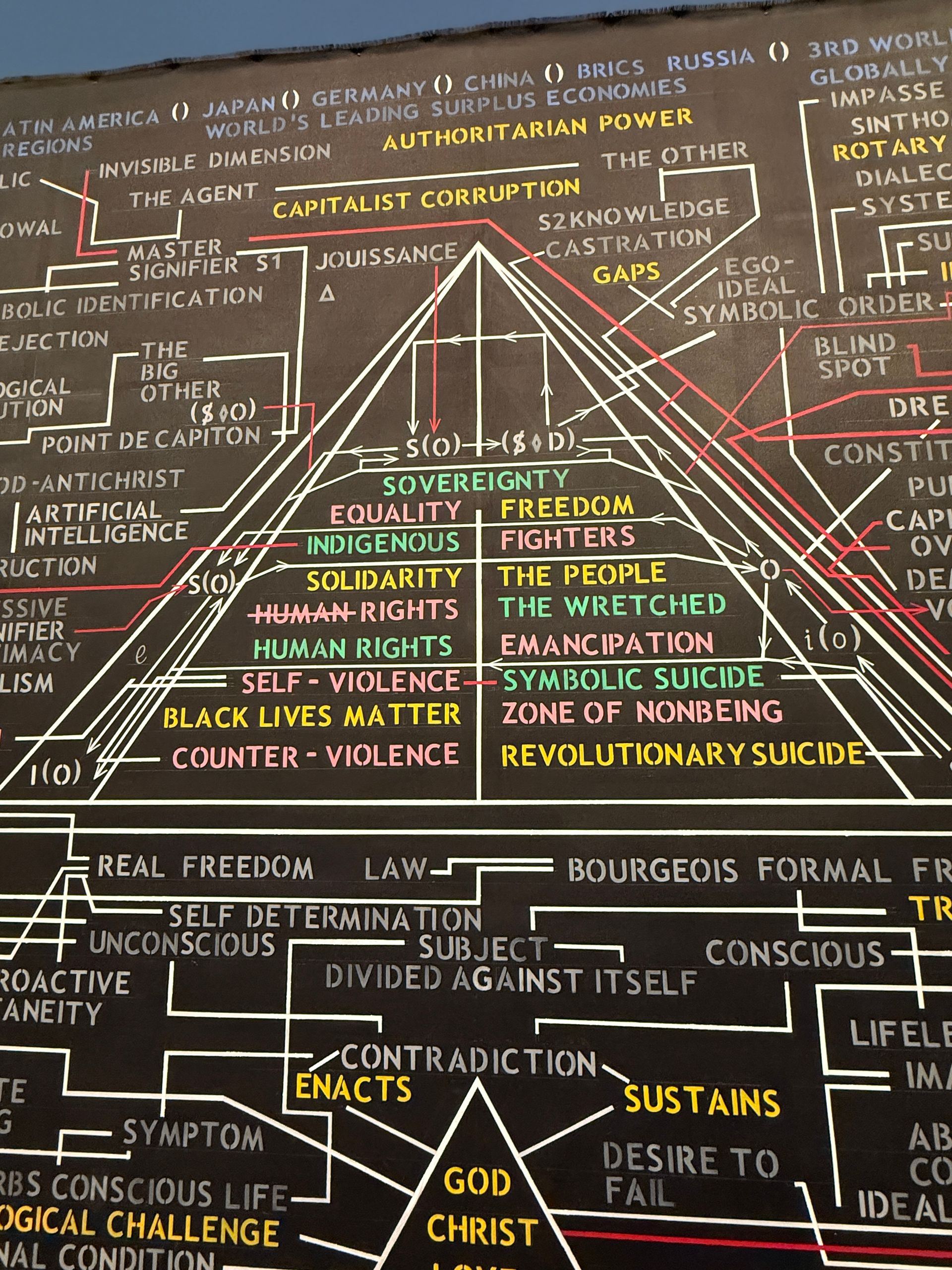

The furthest this game with Joyce is taken is by Sawangwongse Yawnghwe, a painter born in Burma's Shan State, a descendant of the Shan royal family — his grandfather was the first president of independent Burma, before a military coup took everything from them. In the Corderie stands his "People's Desire" (2018): six metres of exodus modelled from two and a half thousand rough clay figurines — families walking and families in boats. On the walls hang his diagram-paintings: "The Idiot's Parallax" (2025) impersonates a screen in the colours of a code editor — stencilled arrows and slogans run across a black ground, Fanon's "zone of non-being," "symbolic suicide," Ukraine, Gaza, the West Bank — a lecture on decolonisation painted like a nightscape; next to it, "The Prince's Manual, or: The Complete Idiot's Guide to Burma Post Coup Revolution," a title straight from the self-help shelf. This is art ostentatiously didactic — the kind Joyce barred from the temple — and yet I could not walk away from it. All these works are political to the marrow. And all of them work in the order Joyce cared about: first they stop you, and only then do they speak.
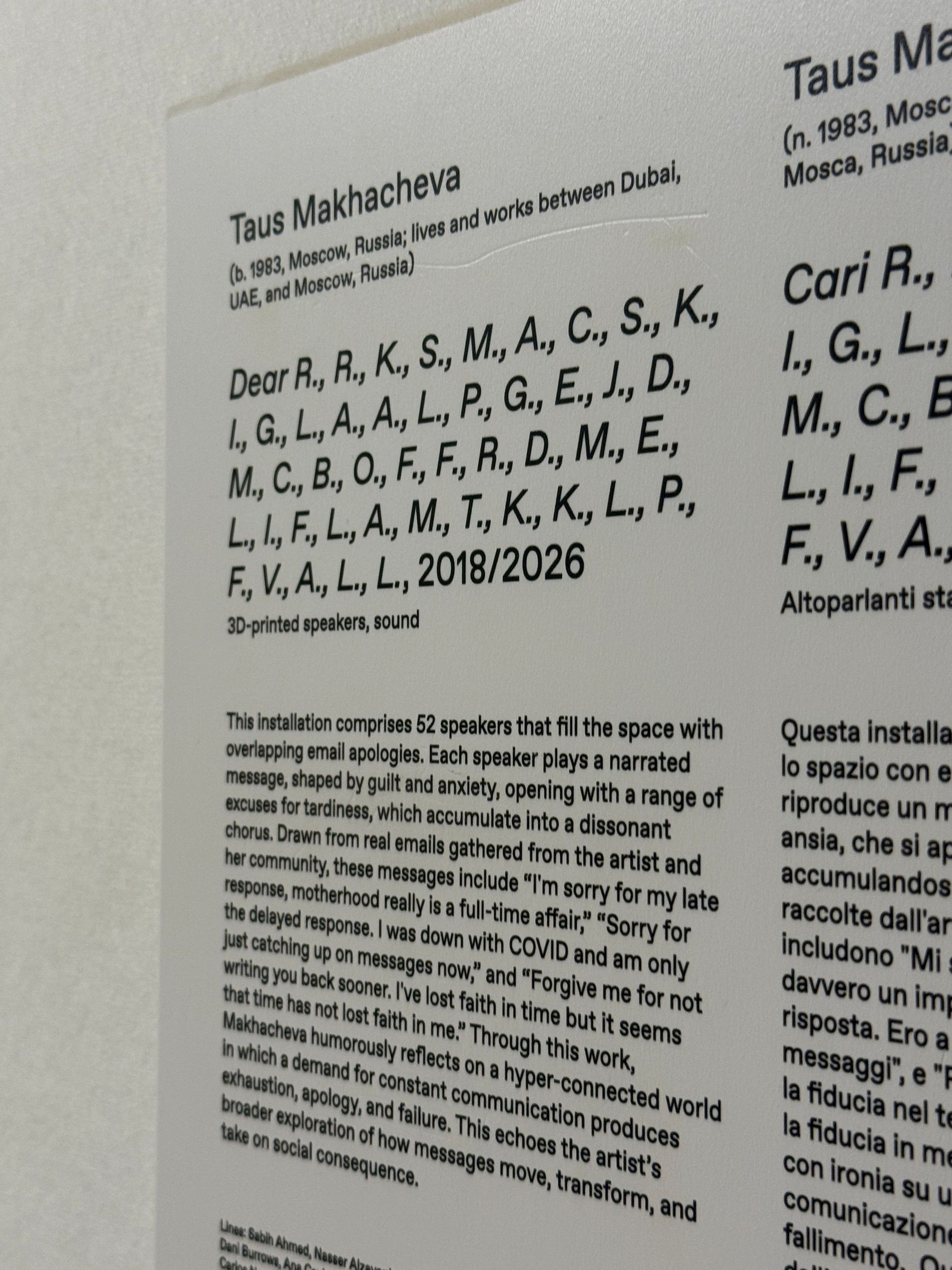
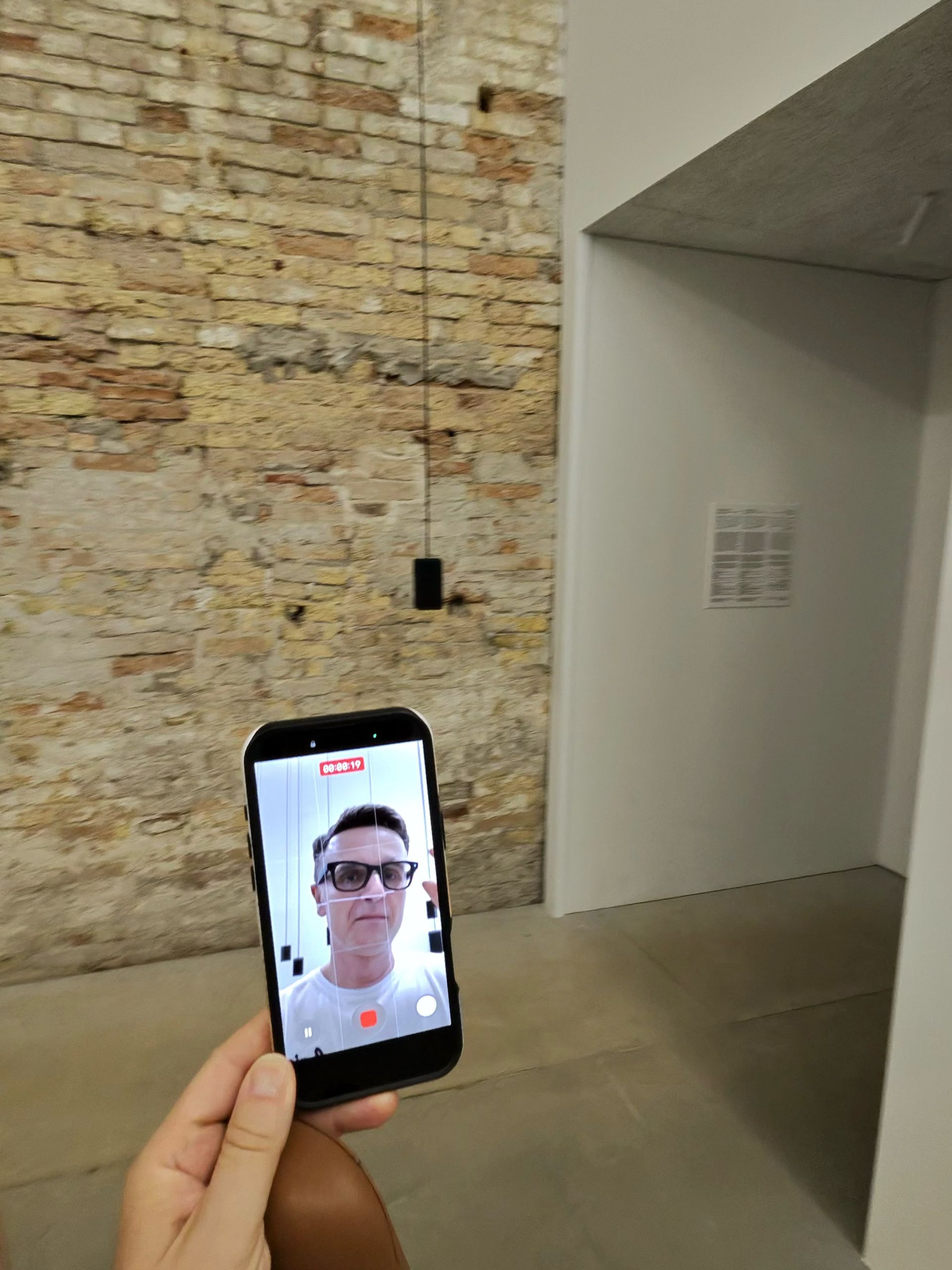
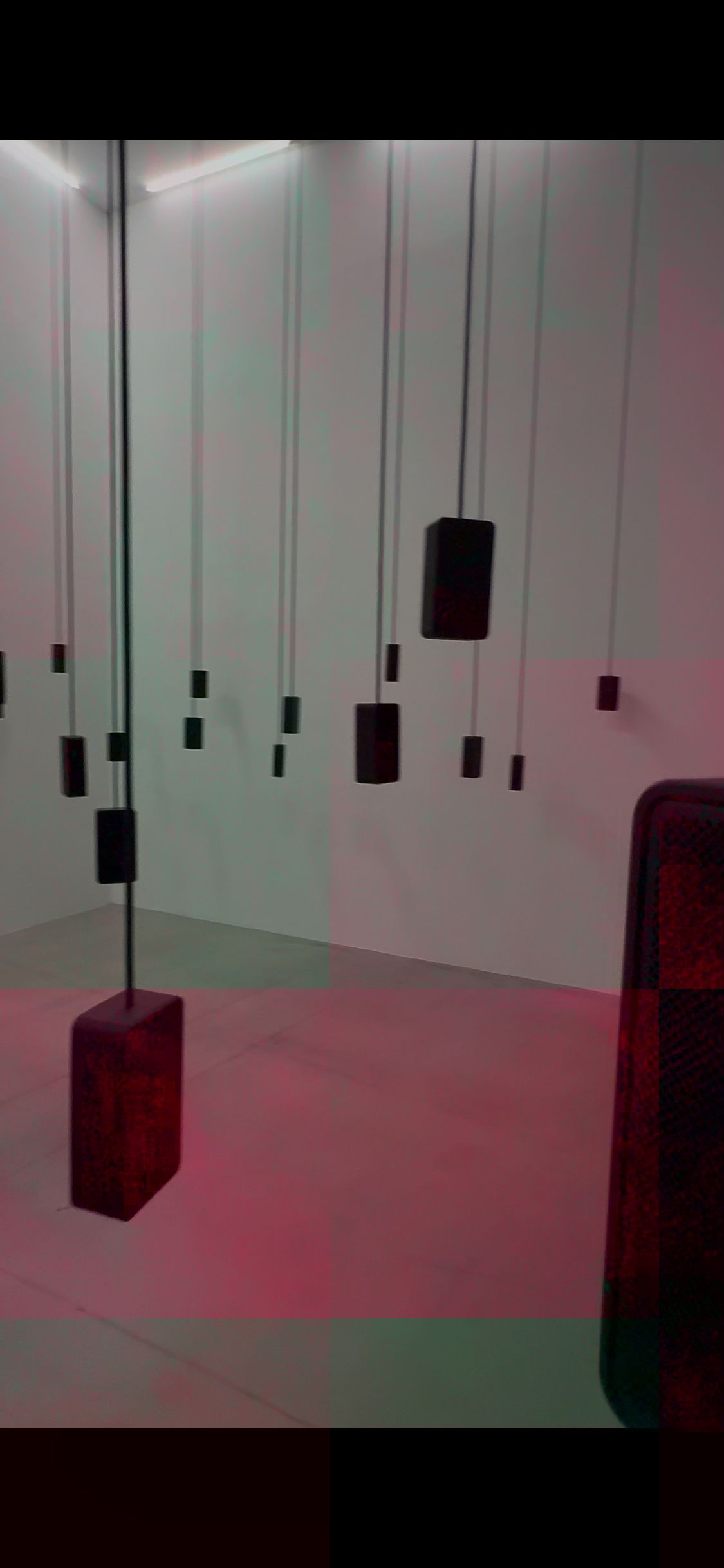

In the pavilion of the Emirates, titled "Washwasha" — Arabic for whisper — fifty-two speakers hang from the ceiling, and out of them, layer upon layer, flow apologies from real e-mails: "I'm sorry for my late response, motherhood really is a full-time affair"; "Sorry for the delayed response. I was down with COVID and am only just catching up on messages now"; "Forgive me for not writing you back sooner. I've lost faith in time but it seems that time has not lost faith in me." I stood in that chorus as if inside my own outbox, listening to a portrait of a civilisation that built a network of instant communication partly so that it would have something to apologise for. Is this didactics? Nobody here wants anything from me. It is a mirror, rather.

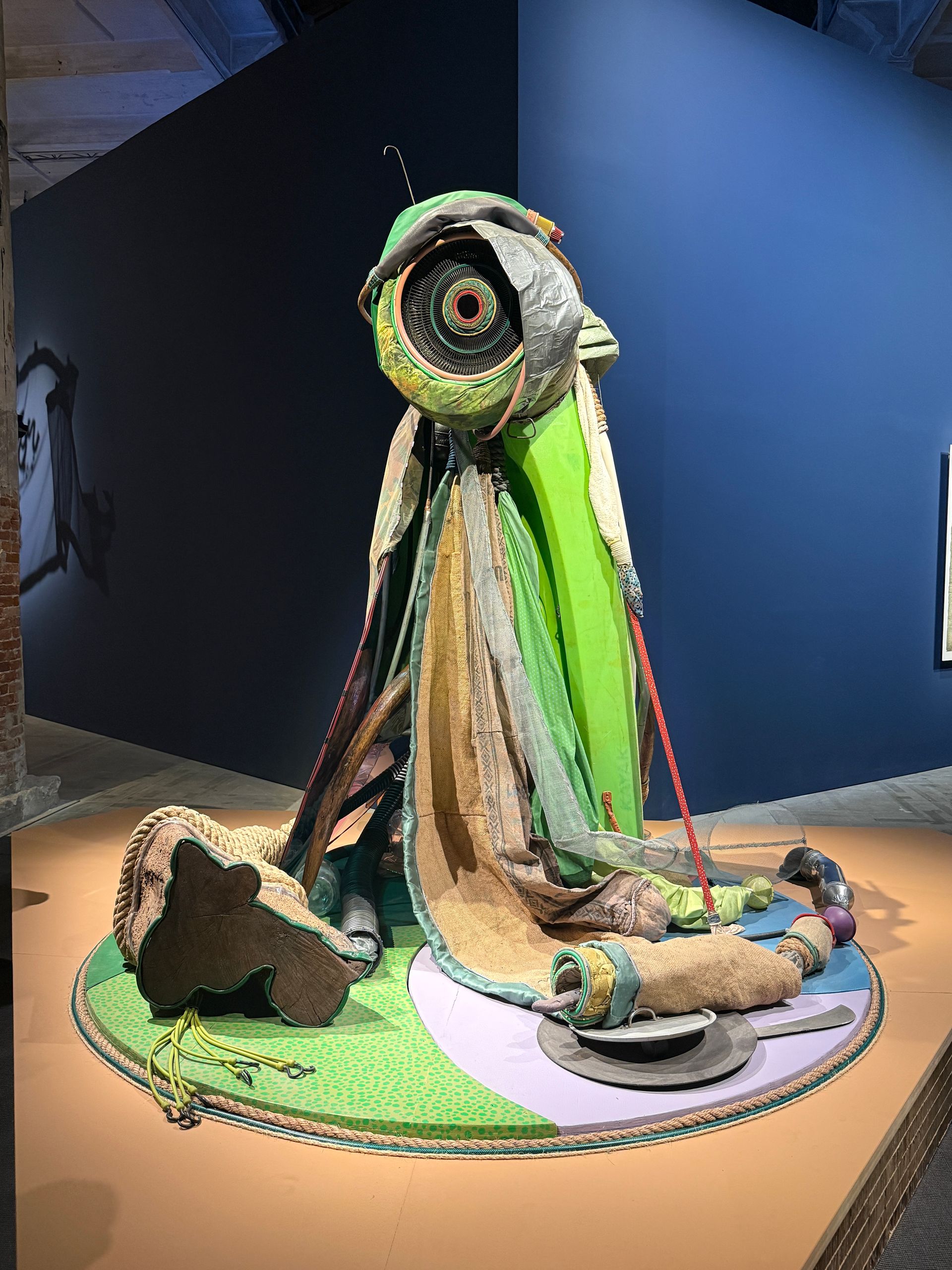
The minor key has its biology too. Otobong Nkanga has let the four modernist columns of the Central Pavilion run wild: hanging gardens, glass terraria, little hotels for bees. In Dan Lie's installation, seeds sprout and fungal spores drift; the work lives and dies over the course of the exhibition, watered like a garden bed, while Linda Goode Bryant grows a real vegetable patch in the Giardini.
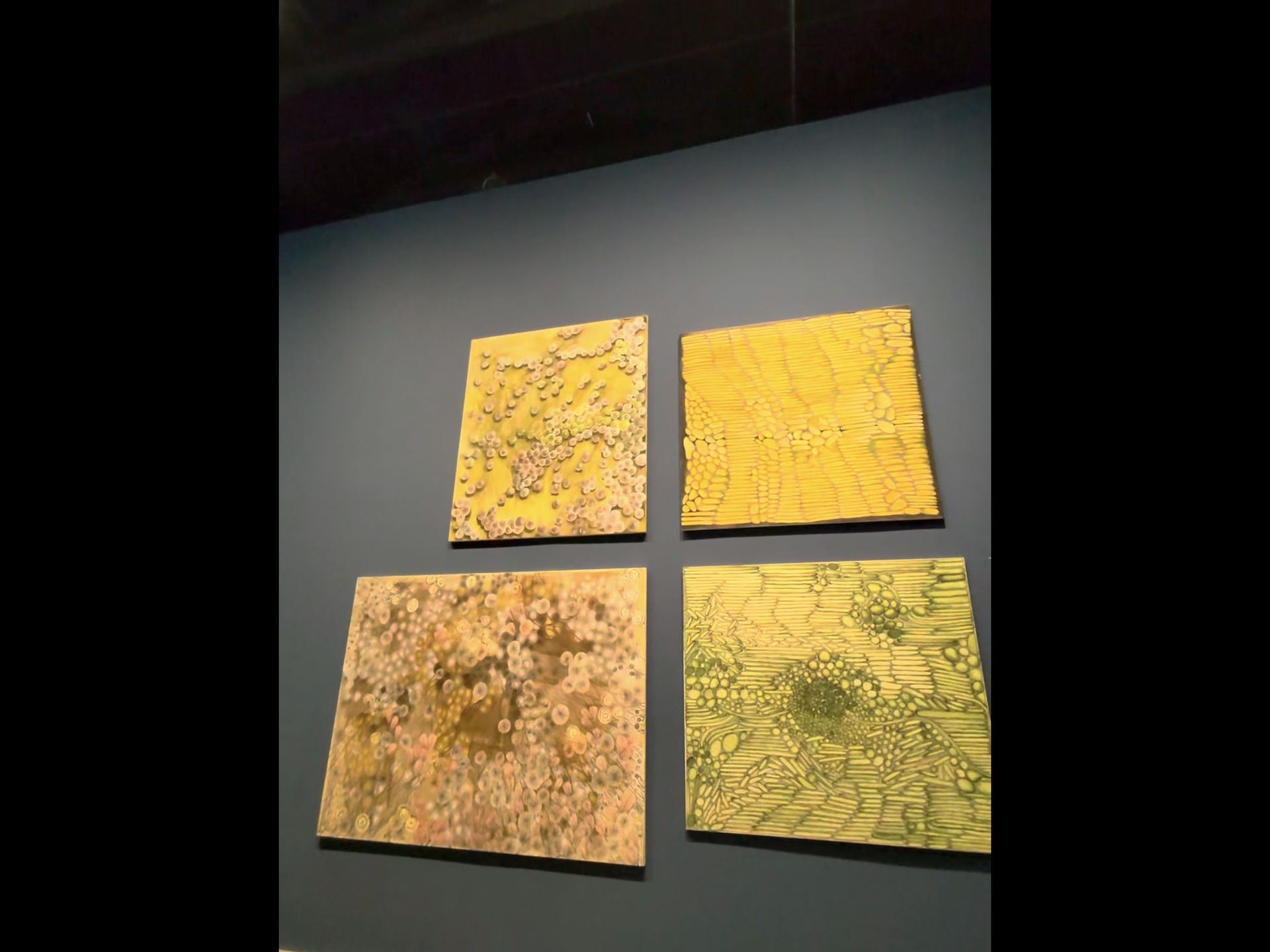
What stopped me longest in this botanical key, though, were four unassuming canvases by Hala Schoukair from the series "The Affirmative Happiness of a Green Dot." Schoukair — a Beiruti, daughter of the great Lebanese modernist Saloua Raouda Choucair — covers white canvases with thousands of small, pale-green touches of the brush, dots like pollen, leaves, cells, and tells how they grew out of childhood walks in the forests of Mount Lebanon her mother used to take her on. "Each painting is a window that needs to be put up against the light," the label reads, and "each brushstroke is a thread in this tapestry of wonder." I stood before those four paintings longer than before many a video machine of this exhibition, and could not leave. Nothing happens in them, but everything is on them. If anywhere at this Biennale I experienced Joycean stasis in its pure state — wholeness, harmony and radiance without a gram of politics — it was there, among green dots growing like moss on a white ground.

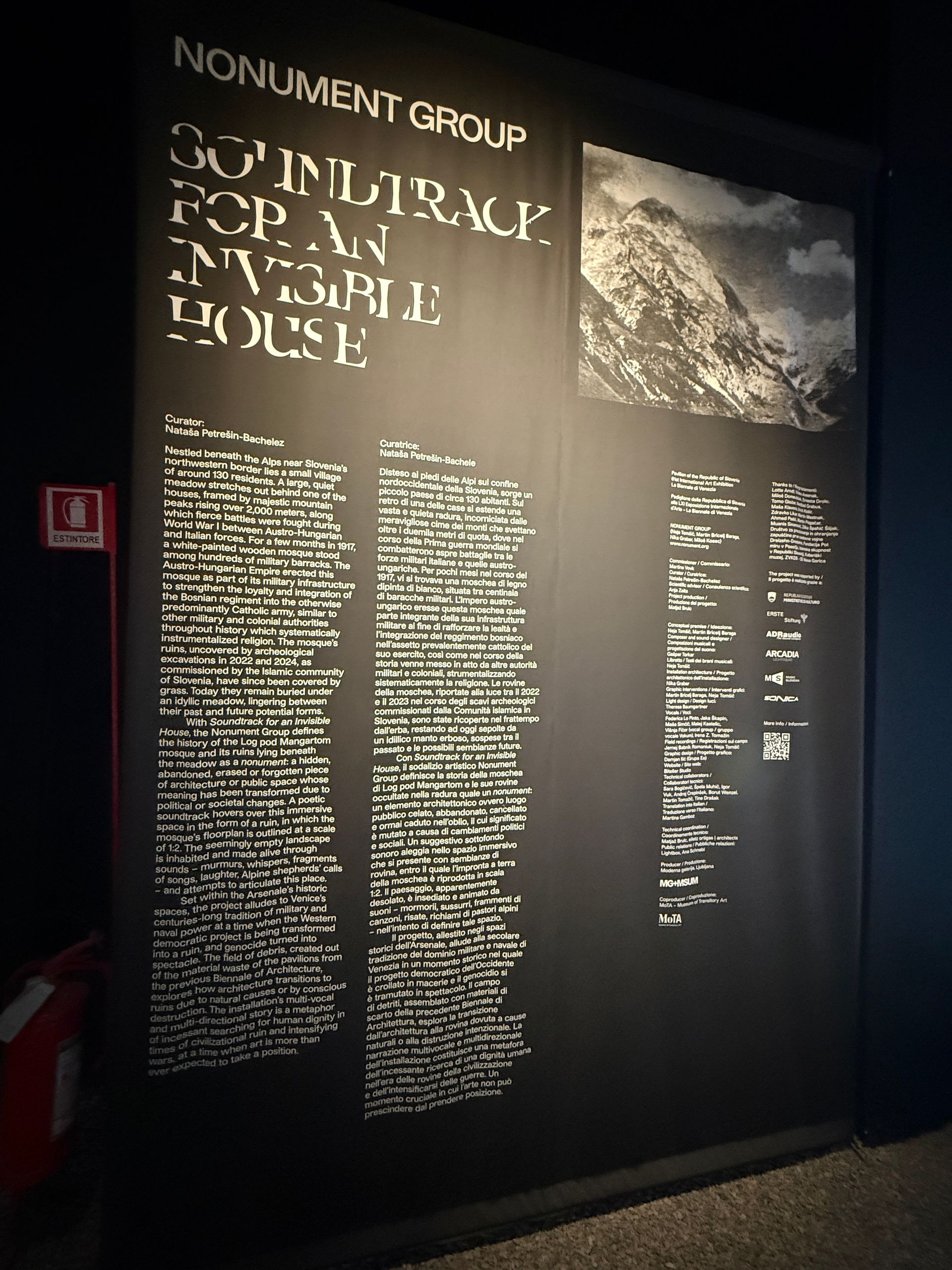
To the same family belongs the pavilion that has not given me peace since: Slovenia's. The Nonument Group has heaped up, in the Arsenale, a ruin made of rubble from the previous Architecture Biennale's pavilions, and inscribed into it, at a scale of 1:2, the floor plan of the mosque of Log pod Mangartom: a white wooden shrine built in 1917 for the Bosnian soldiers of the Austro-Hungarian army fighting on the Soča front. It was the only mosque ever to stand on Slovenian soil, until one opened in Ljubljana a century later. It vanished along with the front line; the foundations were dug up only a few years ago. There are no paintings in the pavilion, no vitrines of documents. There is sound: murmurs, scraps of song, laughter, the calls of shepherds. The empire built its soldiers a mosque because it needed them for its war; for the men themselves, it was simply a place to pray and catch their breath. You stand inside the outline of that invisible house and listen. Religion can be harnessed to any war — and yet the light of that Alpine meadow from a hundred years ago still shines through.
Lebanon, in turn, brought a pure minor key without a single word about its crisis. Nabil Nahas, a painter born in Beirut who has worked between America and Lebanon for over half a century, surrounds the viewer with a forty-five-metre frieze of twenty-six canvases: cedars, fractals, the geometry of Islamic ornament and Western abstraction, the microscopic and the cosmic in a single frame. "Lebanon exists somewhere in between," the artist says; perhaps that is why the pavilion is called "Don't Get Me Wrong." A country in permanent crisis sent Venice nothing but calm — which is also a definition of dignity.
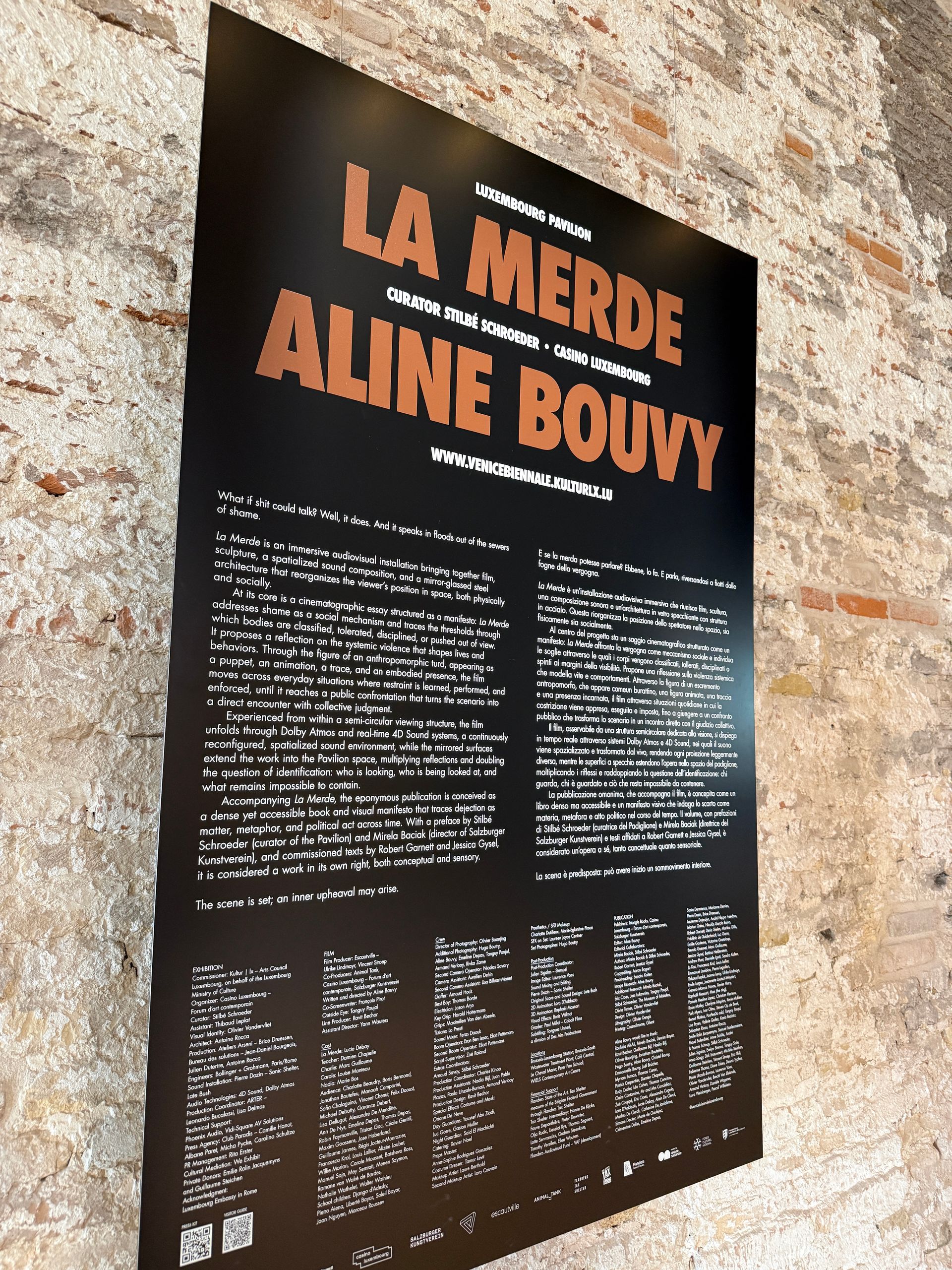
Against this backdrop, Luxembourg's pavilion plays like a trombone at a funeral. Aline Bouvy has titled her installation "La Merde" and made its protagonist a talking, singing, anthropomorphic turd, which — in a film screened inside a mirror-and-steel architecture — wanders through classrooms, buses and bedrooms. "What if shit could talk?" asks the pavilion wall. "Well, it does. And it speaks in floods out of the sewers of shame." The theoretical apparatus is all present and correct: Kristeva, the abject, the reclaiming of what society flushes away.
The trouble is that this shock is sixty-five years old and going grey. Piero Manzoni canned his "Merda d'artista" in 1961: ninety signed tins of thirty grams each, priced at the daily rate of gold (today a tin outprices gold by orders of magnitude — and no one will ever open one, because opening it would kill the value). In 2000 Wim Delvoye built "Cloaca," a digestive machine that defecated with the punctuality of a station clock. Each of those gestures genuinely moved something in its day. Repeated in 2026, in the edition of minor keys, it sounds like a diligently produced quotation from the handbook of provocation. With bespoke architecture, surround sound and a three-hundred-page publication. Joyce would be merciless: loathing is a kinetic emotion, and art founded on it improper by definition. I will be gentler: Bouvy insists she never provokes for provocation's sake, and she probably means it. Except that the only truly kinetic reaction her work produced was not in the visitors — they were taking pictures — but in the Luxembourg parliament, where someone added up the pavilion's cost, five hundred and forty thousand euros, and asked about the country's image. A provocation, then, that moves only the accountants.
The most interesting thing is that shame and the body are being spoken of in the same Venice, in parallel — more quietly and more accurately. In the main exhibition, BuBu de la Madeleine, a veteran of Kyoto's Dumb Type group, sews flags out of gauze, wire mesh and reclaimed cloth: banners shaped like internal organs, the standards of her own body after a hysterectomy, hung out in the wind, free of gravity and of shame. Without a single decibel of scandal, they deliver everything the Luxembourg pavilion promises in its press kit.

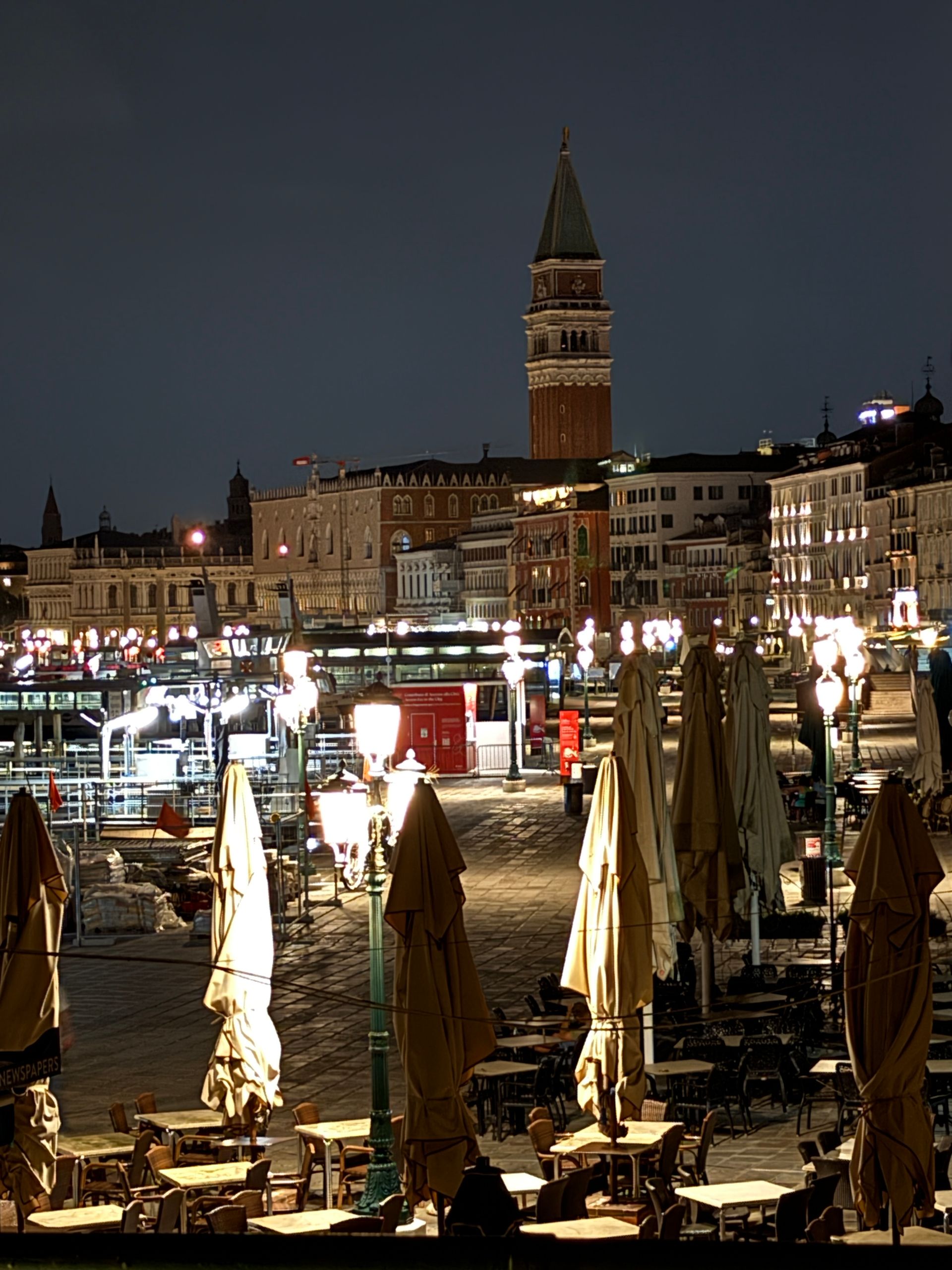
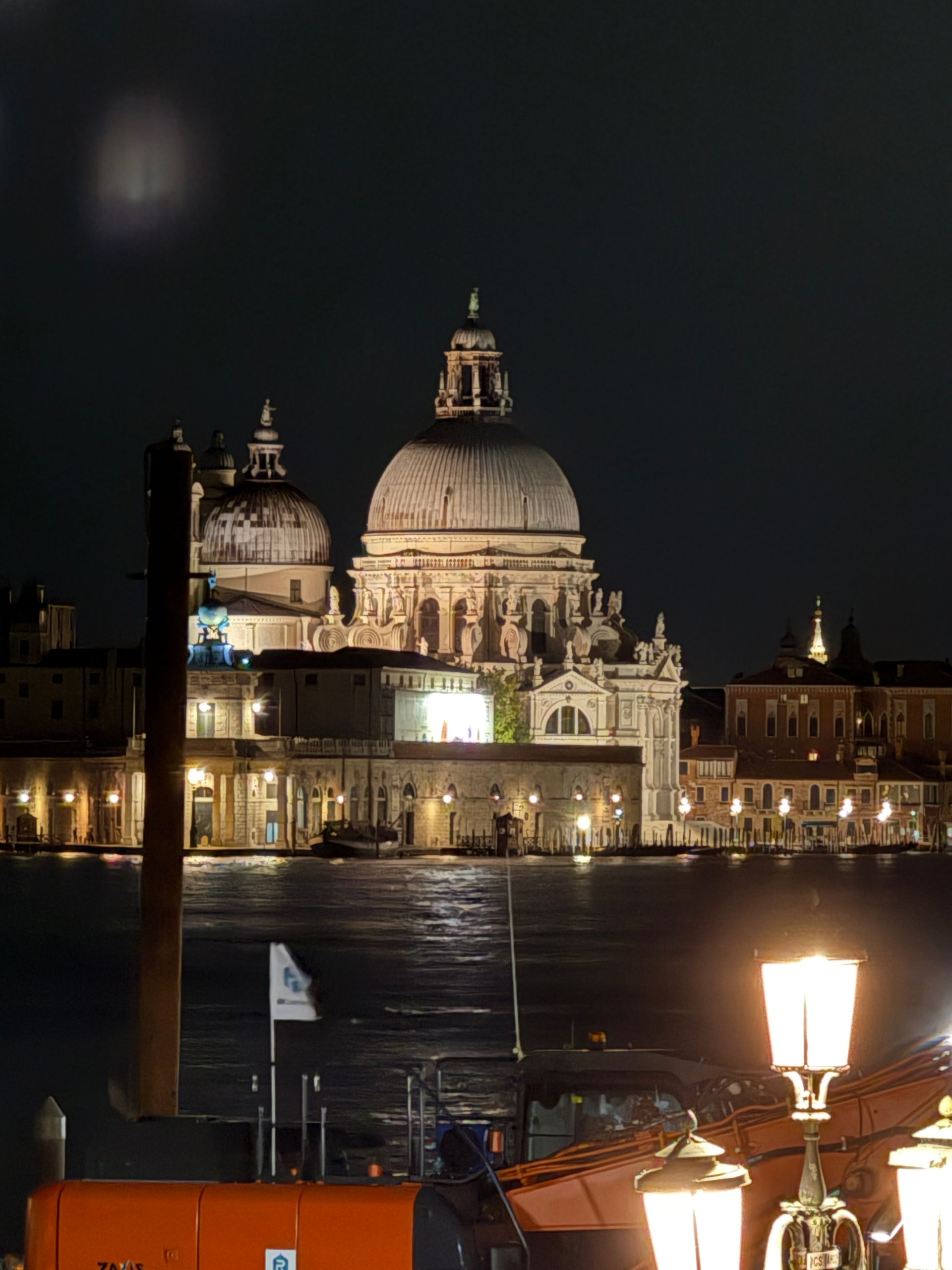
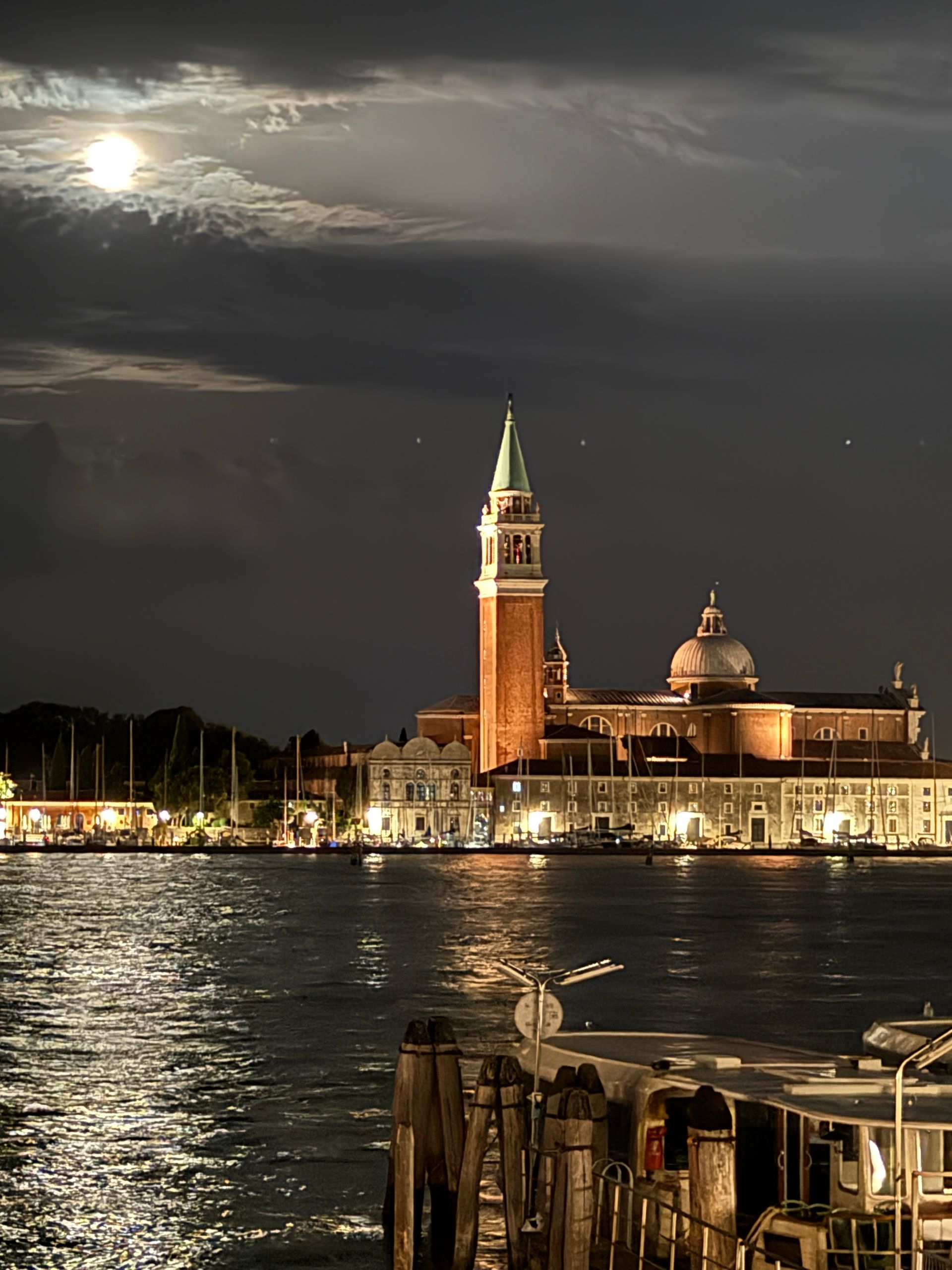
On my last evening I went back to St Mark's Square, to Kantor. In the dark rooms of the Procuratie, the mannequins of "The Dead Class" sit at their school desks — old people with their child doubles, exactly as they toured half the world between 1975 and their author's death. Beside them, on a screen, Wajda's recording: the performance goes on, though everyone who performed it is gone. For fifteen years Kantor carried his dead class around the world — carrying the dead so that the living could live; the titles of his final cycles, "Nothing Further" and "I'm Falling, Dammit," sound like minor keys forty years before Kouoh.
Walking out of the Giardini the next day, I passed the deer once more. It still hung in its harness, between evacuation and arrival, waiting for a pedestal no one has yet promised it — like a fair part of the world whose works have been carted here. I thought about my unicorn: memory had fitted the animal with a horn, turned a refugee into a myth. Campbell would have smiled — that, he said, is exactly how wonder works: it takes a thing into a frame and passes through it a light that, "objectively," the thing does not contain.
[Take a deep breath].
[Exhale].


