
On 2 October, Legia Warsaw will begin their UEFA Conference League campaign. Their first visitors to Łazienkowska Street will be Samsunspor, a Turkish club from the Black Sea city of Samsun. Though Thursday’s opponents are far from Turkey’s oldest club, the fixture offers an excellent opportunity to examine how football in Turkey looks, works and feels.
The Turkish game is a fascinating phenomenon. Seen in its full context, it reveals much not only about sport, but also about the country’s culture, politics and society. Let us therefore embark on a journey to a place where football has become something close to a religion.
If football is Turkey’s second religion after Islam, its first missionaries were Englishmen. Sailors, merchants and soldiers were playing matches as early as 1875 in Thessaloniki, then part of the Ottoman Empire. Greeks and Armenians were also quick to embrace the game. Muslim Turks, by contrast, long viewed this new pastime with suspicion. The first Turkish club, Black Stockings FC, was not founded until the end of the 19th century and played only one match — one that was brutally broken up by the Sultan’s police.
In 1904, the Constantinople Football League was launched, still dominated by foreigners. It was only later that the political movement known as the Committee of Union and Progress began encouraging young Turks to take up this modern sport. Football was already becoming an instrument of modernisation — and a stage on which broader political and social currents were reflected.
The first decade of the 20th century brought the birth of Turkish football’s “big three”: the elite Galatasaray in 1905, the popular Fenerbahçe in 1907, and Beşiktaş in 1910, rooted in a working-class district. Their names and colours still electrify millions. The rivalry between Galatasaray and Fenerbahçe is among the fiercest in Europe. At the same time, teams from the Ottoman Empire — including sides from Thessaloniki and Smyrna — even made their debut on the Olympic stage.
After the first world war and the collapse of the Sultanate, football became for Turks a form of release and a source of hope. Symbolic was a match in 1923, when Fenerbahçe defeated a team representing the British occupiers. That same year saw the birth of the Turkish Republic. Its leader, Mustafa Kemal Atatürk, made football part of his grand modernising project: alongside the new alphabet, the secular state and women’s rights, sport too was to become one of the foundations of modern Turkey.
The year 1923 also brought the creation of the Turkish Football Federation and the national team’s first official match, a 2-2 draw against Romania. A year later, the first national competition began, quickly becoming a celebration of the young republic. Within a few decades, football had travelled from a persecuted amusement of foreigners to a symbol of modern national identity.
The turning point for Turkish football came in 1959, with the creation of the National League — the first nationwide round-robin competition. A second division soon followed, and since 2001 the top tier has been known as the Süper Lig. Another important year was 1962, when Turkey joined UEFA, despite lying mostly in Asia. This was both a sporting and a political decision: part of the country’s broader turn towards Europe, and a way for Turkish migrants in Germany and France to watch their clubs compete on European pitches.
From the outset, the league was dominated by Istanbul clubs. Galatasaray, Fenerbahçe and Beşiktaş divided the titles among themselves until 1976, when Trabzonspor broke their monopoly. Even today, only six clubs have ever won the Turkish championship — a sign of just how concentrated the domestic game remains. Beyond the league, the Turkish Cup also carries significance. Open to teams from every tier, it has occasionally produced genuine surprises. One came in 1980-81, when MKE Ankaragücü, then playing in the second tier, won the cup and was “rewarded” with promotion to the top division.
The real flowering of Turkish football came around the turn of the century. In 2000, Galatasaray won the UEFA Cup and UEFA Super Cup. Two years later, Turkey’s national team took bronze at the World Cup. In 2008, Turkey reached the semi-finals of the European Championship, strengthening the country’s position on the football map. These successes helped Turkish players move more frequently to Europe’s leading leagues, while the Süper Lig began attracting global names such as Didier Drogba, Roberto Carlos and Robin van Persie.
The past two decades have also brought fairly regular Turkish appearances in European competition. Fenerbahçe reached the Champions League quarter-finals in 2008 and the Europa League semi-finals in 2013. Beşiktaş impressed in the Champions League in 2017-18, while Başakşehir reached the last 16 of the Conference League in 2023. Football is now Turkey’s favourite sport — three-quarters of society say so — and the Süper Lig ranks among Europe’s stronger competitions both in sporting level and in the market value of its players.
Turkey currently stands ninth in UEFA’s association ranking, while Poland is 14th. The financial gap is similarly clear. This season, the combined value of Süper Lig squads is, according to Transfermarkt, more than €1.3bn; in Poland’s Ekstraklasa, the equivalent figure is just under €370mn. Turkey’s national team is 27th in the FIFA ranking, ahead of Poland in 36th. These figures show that Turkey has firmly established itself on Europe’s football map. Another opportunity for development lies ahead: in 2032, the country will co-host the European Championship with Italy. Preparations are already under way.
Although Ankara is Turkey’s constitutional capital, Istanbul remains its footballing centre: a city of seven Süper Lig clubs and home to the world’s only intercontinental derby. It is here that Galatasaray, Fenerbahçe and Beşiktaş compete, alongside Başakşehir, each helping shape the football identity of Turkey’s largest city, with more than 15mn inhabitants.
Galatasaray, founded in 1905 by pupils of a prestigious school on the European side of the city, is regarded as an elite club and is also the most popular in the country. It is Turkey’s most decorated side, with 25 league titles, known for European success — the UEFA Cup and Super Cup in 2000 — and for a stadium atmosphere so loud it turns the ground into a fortress.
Across the Bosphorus, on the Asian side, Fenerbahçe dominates. Founded in 1907, it is a club with a patriotic ethos and a history linked to resistance against British occupation. Matches against Galatasaray, known as the derby of two continents, symbolise the clash of two forces within modern Turkey. They also generate extraordinary passion: it was at a Galatasaray-Fenerbahçe match, at Galatasaray’s stadium, that the Guinness world record for crowd noise was set at 131.76 decibels.
The third force is Beşiktaş, rooted in a working-class European district. Its rebellious and radical supporters, known as Çarşı, are famous for their hostility not only towards local rivals but also, when results disappoint, towards their own coaches — and towards the apparatus of state power.
Against the backdrop of this “big three”, Başakşehir tells a different story. A younger club backed by the political milieu of President Recep Tayyip Erdoğan, it emerged partly from disappointment that Galatasaray, Fenerbahçe and Beşiktaş fans had taken part en masse in anti-government protests in 2013. Critics have even dubbed it “FC Erdoğan”. Though attendances are modest compared with the big three, its political backing and financial support helped it win the Turkish title in 2019-20 and compete regularly in Europe. It is this collision of progressive Galatasaray, popular Fenerbahçe, rebellious Beşiktaş and young, ambitious Başakşehir that makes Istanbul derbies among the most charged spectacles in European football.
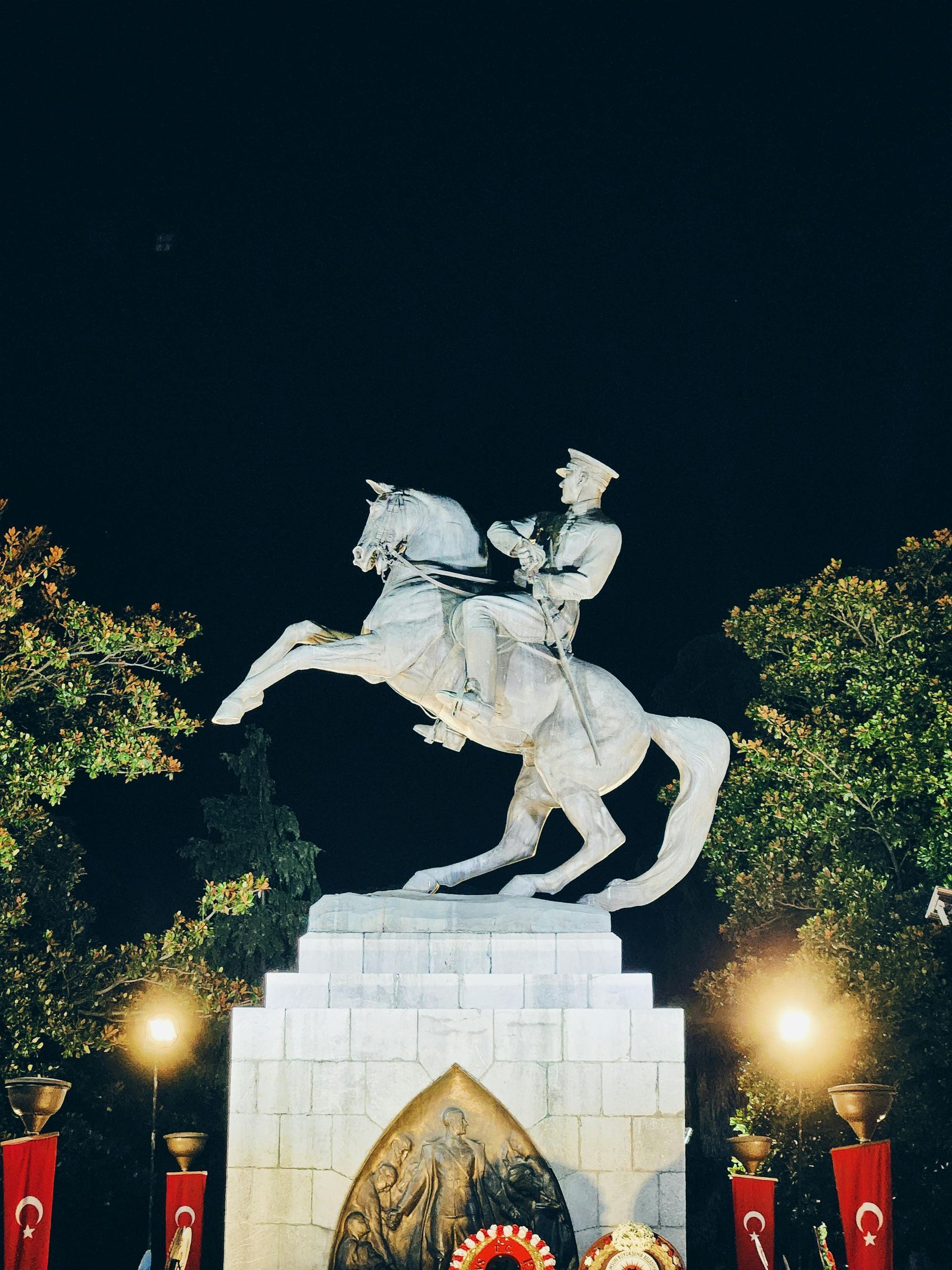
This season, Legia will not face any of Istanbul’s clubs in the Conference League league phase. Their Turkish opponent this week is Samsunspor, a team from Samsun, a city on the Black Sea in the Asian part of Turkey. It is worth noting that the “-spor” suffix in many Turkish club names simply means “sport”. Although Atatürk’s monument appears on the club crest, Samsunspor does not have a history as long as that of Istanbul’s big three: it was founded in 1965. Yet it has an identity, loyal supporters and an indomitable spirit — one that has allowed it to fight on despite adversity and return, in style, to the company of the best.
Samsunspor’s colours are white, red and black. The first two are the colours of the Turkish flag. The black commemorates the tragedy that struck the club in 1989. On 20 January that year, the team bus was involved in a fatal crash. Head coach Nuri Asan and three players were killed, while many others suffered serious injuries. Some were forced to end their professional careers. As a result, the club could not continue the season. Its remaining fixtures were recorded as 3-0 walkover defeats. The disaster led the Turkish federation to grant Samsunspor the title of “honorary champion of Turkey” for the 1988-89 season and to spare the club relegation despite finishing bottom. Public sympathy and preferential treatment from the federation did not, however, prevent relegation the following season, or a period of movement between the first and second tiers in the early 1990s.
The second defining element of Samsunspor’s identity, alongside the memory of the 1989 crash, is the Smurfs — Şirinler. This is the name given to the club’s most devoted fans, for whom Samsunspor is quite literally a way of life. Their signature spectacle is the “path of light”: a march from the city’s main street to the stadium, flares burning along the way. On matchdays, the whole city glows red, radiating footballing energy. Şirinler created some of the first fan websites, produced their own merchandise and ran an internet radio station, building a distinctive culture around the club. Though they have at times been suspended for overly colourful chants — once receiving a one-year stadium ban, later reduced to 42 days — they have always returned to the stands with even greater energy. The Smurfs are at their most active when Samsunspor face their more decorated regional rival Trabzonspor, in fixtures often referred to as the Black Sea derby.
In sporting terms, Samsunspor are known for their fighting spirit. In the 21st century, they were long seen as a yo-yo club, shuttling between divisions. They played in the Süper Lig from 2000-01 to 2005-06, but began the 2006-07 season in the second tier, newly branded as the First League. They returned to the top flight for 2011-12, only to suffer relegation again at the end of the campaign. Their situation became even more dramatic after the 2017-18 season: poor performances, a last-place finish and financial problems sent the club down to the third tier. Sporting collapse was accompanied by institutional crisis. A court-appointed administrator was installed, and an investigation into mismanagement by the previous board was launched.
Yet a light appeared in the darkness: former president İsmail Uyanık stepped in to rescue the club. Under his leadership, the football operation was restructured into a separate joint-stock company. Uyanık took a 33 per cent stake, while the rest was controlled by the industrial Yıldırım Holding. Six months later, the holding’s shares were acquired by Yüksel Yıldırım himself, the company’s owner. In 2019, Uyanık withdrew from the club, leaving Yıldırım as its sole owner; in 2020, he also became its president.
Organisational reform was followed by sporting renewal. The club established coaching partnerships with local amateur teams, reformed its academy and signed a youth-development agreement with Belgian club KRC Genk. The slow climb back towards the Süper Lig had begun.
Samsunspor finished the 2019-20 season top of the third tier, winning promotion to the First League. At the end of 2022-23, the club returned to Turkey’s top flight. In 2024-25, they finished a sensational third, opening the door to European football. Like Legia, the Turkish side tried their luck in Europa League qualifying this season; they dropped into the Conference League after losing a two-legged tie to Greece’s Panathinaikos.
The club’s recovery from financial and sporting distress, and its return to the upper reaches of Turkish football, is a story that shows how quickly positive change in football can happen. It also shows that organisational and financial reform can translate into sporting success. No wonder Resul Akçay, a Turkish sports journalist and author of a book about Samsunspor’s dramatic recent years, described president Yıldırım as “Braveheart”.
Turkish football has many bright sides. One is undoubtedly its supporter culture. On matchdays, cities quite literally live football. At the biggest grounds, crowd noise exceeds 100 decibels and is often compared to a jet engine taking off. Support for Turkey’s oldest clubs is passed “from generation to generation”; nobody is surprised to see children, fathers and grandfathers attending matches together. Turkish fans are also known for their openness. A foreign football supporter who, for whatever reason, turns up at a Turkish stadium to watch a local match can expect a warm welcome, genuine curiosity, a crash course in the club’s history and chants — and then long conversations about football over successive glasses of hot Turkish tea.
Another defining feature is football’s close relationship with politics. This is hardly surprising given that Recep Tayyip Erdoğan, Turkey’s current president and former prime minister, played in his youth for local club Camialtıspor, where he came to understand football’s importance to Turks. Politics in Turkish football is not limited to Başakşehir, the club created in part as a counterweight to the anti-government supporters of the big three. It also includes major state investment in sport. Since 2007, a programme to build or modernise “30 stadiums in 27 cities” has been pursued by the Ministry of Sport together with TOKİ, the state housing agency. The programme has given a development boost to clubs outside the country’s biggest cities, whose supporters often had to cheer their teams in grounds dating back to the 1950s. The new national stadium is being built in a similar fashion. The state was also involved in the extensive renovation of Istanbul’s Olympic Stadium, which enabled it to host the Champions League final in 2023.
The state’s presence in Turkish football also extends to finance. In 2019, an agreement was reached between the Turkish Football Federation and the Turkish banks’ association, in which the state-owned Ziraat Bankası played a key role. The deal concerned the restructuring of the debts of leading clubs. The beneficiaries were the country’s powerhouses: the Istanbul big three and Trabzonspor. The same Ziraat Bankası is also the title sponsor of the Turkish Cup, providing the competition with stable funding. Spor Toto, the state betting operator, also plays an important role in financing Turkish football and Turkish sport more broadly. Turkish researchers Gökhan Acar and Kayhan Serin have estimated that between 2004 and 2017 the organisation paid more than TL18bn into the state budget — about €7.5bn at the average exchange rate over that period — and took part in the construction of nearly 2,500 sports facilities across the country.
Yet state involvement in Turkish sport also has its darker side. Discussions of Turkish football often include allegations that clubs are used for propaganda, and that military symbolism is being introduced into sporting life. Controversy erupted, for example, when Turkish national team players performed military salutes during matches in 2019, widely interpreted as support for Turkish army operations in the Middle East. In 2017, at President Erdoğan’s request, the Turkish federation removed the word “arena” from the names of sports venues, citing a desire to protect the Turkish language. Instead of the foreign “arena”, the preferred term became the more Turkish-sounding “stadyumu” — though that word itself derives from Greek. Politics is also present in the stands, where fans can loudly voice dissatisfaction with those in power. That, however, is as old as sport itself.
Turkish football is a lens through which the history, modernity and emotions of contemporary Turkey come into focus: from English “missionaries” at the end of the 19th century, through Atatürk’s republican modernisation, to today’s seething terraces and political controversies. It is a league in which great metropolises and proud regions collide not only on the pitch, but also in the realms of symbols, language and politics. That is why every match against a Turkish opponent is an encounter with an entire world of meaning: with a passion that can carry teams beyond their objective limits, and with a culture that, though sometimes hard-edged, is authentic and magnetic.
Samsunspor are a useful gateway into this world: a club younger than the Istanbul giants, but shaped by the strong identity of its city, the memory of the 1989 tragedy and a supporter culture that colours everyday life on the Black Sea. In recent years, the club has returned to the elite, and its journey — from collapse to promotion and a European debut — is a reminder that in Turkish football determination and emotion can compensate for constraints. This is not an opponent that gives games away. It is a team nourished by atmosphere, capable of imposing intensity and rhythm.
On 2 October in Warsaw, two strong local identities will meet: Legia, a symbol of the capital with its own ethos of victory and fighting to the end; and Samsunspor, the pride of a port city, carrying the burden of history and the fresh hunger of European competition. It will be a contest of emotion, character and energy from the stands. Home advantage is on our side. We hope players and supporters alike will show their class — and give one another wings for a strong start to the Conference League campaign.


