
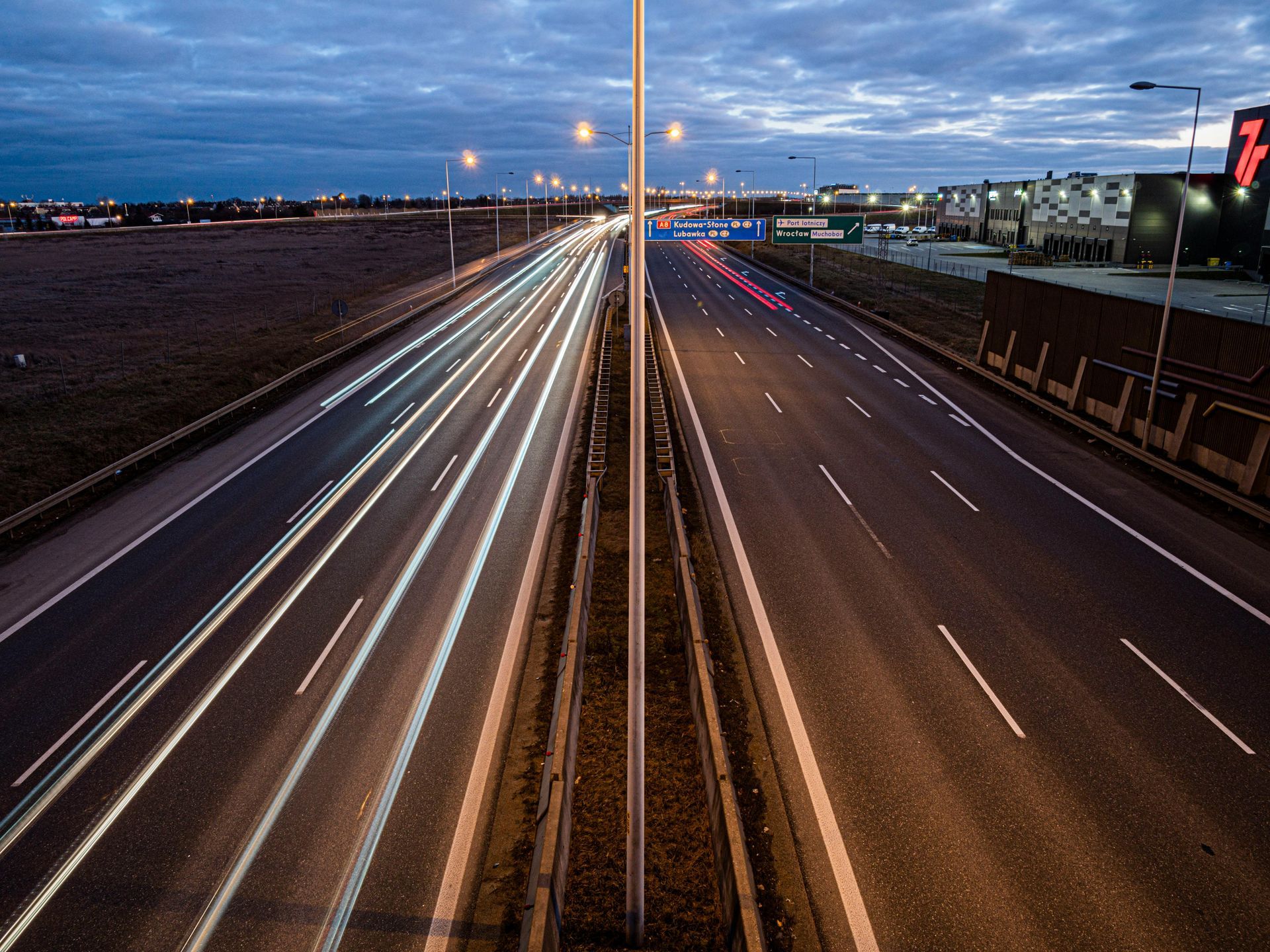
In the Polish imagination, Europe long appeared as a continent threaded with wide motorways: the arteries of economic progress. For decades, however, Poland remained a blank spot on that map. At the start of the 21st century, its motorway network was still modest and fragmented, while driving from the western to the eastern border meant hours on narrow national roads. The story of Poland’s motorways is one of repeatedly frustrated ambition: from pre-war German plans, including the Berlin–Wrocław route begun in the 1930s; through Edward Gierek’s “Olympic road”, conceived ahead of the 1980 Games and of which barely 34km near Poznań was ever built; to the many post-1990 attempts to close the country’s infrastructure gap. In the mid-1990s, government plans still envisaged 2,600km of motorways. Fiscal and institutional reality soon forced those ambitions down. At the turn of the century, Poland had only around 500km of motorway—far short of what a country of its size required.
The award of UEFA EURO 2012 to Poland and Ukraine became the catalyst for an unprecedented acceleration in road building. The years 2008–12 brought an infrastructure leap: nearly 450km of new motorways were opened in Poland, with the largest annual additions in 2011, at 210km, and in 2012, at almost 241km. In just a few years the motorway network doubled, markedly narrowing the gap with the “old” EU. The priority was to complete the main transit corridors before the tournament, above all the A2 and A4 motorways, linking host cities and connecting Polish roads to the wider European network. A symbolic moment came on December 1st 2011, when the Nowy Tomyśl–Świecko section of the A2 was opened, completing the motorway link between Warsaw and Germany. At the ceremony, President Bronisław Komorowski declared that “this motorway connects Poland with Europe’s motorway system. We are closer to fulfilling Polish dreams; we are closer to Europe.” And so it was: entering the A2 at Świecko now meant a smooth drive almost to Warsaw and, via Germany’s A12, onward to Berlin.
There was, however, an important caveat. The motorway reached Warsaw itself only just before the tournament. After the collapse of the Chinese contractor on the final Stryków–Konotopa section, it was opened in June 2012 only as a passable route, with speed restrictions and without its full wearing course. In the south, meanwhile, the A4 was extended before EURO 2012 into a continuous route from the German border at Zgorzelec, through Wrocław, Upper Silesia, Kraków, Rzeszów and Jarosław—within striking distance of the Ukrainian border. After decades of delay, Warsaw and other key metropolitan areas at last acquired modern road links. Paradoxically, the Polish capital was one of the last in Central Europe to gain a motorway on its doorstep. By the eve of the tournament, Poland’s motorway network had passed the 1,000km mark, inserting the country into the continent’s main transport bloodstream.
This spectacular progress was not accidental. It reflected the convergence of EU money, political determination and new delivery models. The government’s 2008–12 national road-building programme envisaged more than 120bn złoty of spending, including 35bn złoty from EU funds, and clearly identified priority sections “for Euro”. The programme committed the state to completing all the key corridors by 2012: the A1 running north-south, the A2 running east-west and the A4 along the country’s south. Crucially, it also embraced different financing models: traditional budget funding, a road fund fed by user charges, and public-private partnerships on selected sections. PPP projects, though difficult to implement, played an important role in parts of the motorway network, setting precedents and offering lessons for the future. The A2 in particular became a testing ground for PPP, probing the maturity of Polish public institutions in working with private capital.
The A2 has a long history, reaching back to the interwar period and the second world war, when Germany laid out sections of the route and prisoners worked on stretches near Poznań. Under communism, only short fragments were completed, including the aforementioned “Olympic road” between Września and Konin. After 1989, the embarrassment of Poland’s road backwardness forced the government to look for new methods. Thus was born the idea of entrusting motorways to private investors, who would finance and operate them in exchange for the right to collect tolls.
As early as 1993, on the initiative of Jan Kulczyk, Autostrada Wielkopolska S.A. was established. In 1997 it obtained a concession to build and operate the tolled A2 from Świecko to Stryków near Łódź. This was a pioneering build-operate-transfer project: the private partner would build the road, earn revenues from it for several decades and then transfer it to the state.
Despite the early enthusiasm, the project remained stuck for years at the financing stage. Domestic and international banks, including the EIB and EBRD, were cautious about lending to such a large scheme in a country with no real motorway experience. They feared traffic might fall short of forecasts and that drivers would resist paying high tolls. As a result, although AWSA signed the concession agreement in 1997, it was unable to reach financial close for another three years.
In 2000 the government finally agreed to guarantee repayment of the EIB loan taken out by AWSA for the Konin–Nowy Tomyśl section. That allowed the financial contracts to be signed in October 2000 and construction of the first stage of the A2 to begin. The financial model relied heavily on debt: nearly 75% of costs were covered by loans from the EIB and commercial banks, with the remainder coming from the consortium’s equity. Such leverage was not unusual. It is a typical feature of project finance, where debt—cheaper than equity—is maximised to lower the weighted cost of funding. In return for committing both its own money and bank financing, the concessionaire received the right to collect tolls from drivers on the completed section for 40 years, until 2037. From the state’s perspective, the EIB loan guarantee proved worthwhile: it unlocked financing on favourable terms while sparing the budget an immediate outlay.
Construction began in 2001, and by the end of 2004 drivers could travel by motorway from Nowy Tomyśl to Konin. AWSA opened the route in stages: first the modernised Września–Konin section, 47.7km, in December 2002; then the new Poznań–Września stretch, 37.5km, in 2003; and finally the Nowy Tomyśl–Poznań section, 50.4km, in 2004. Wielkopolska had acquired its motorway: the first long tolled route of its kind in the Third Polish Republic.
The weaknesses of the concession model soon became apparent. The contract gave the private operator the right to set toll rates according to an agreed formula, on the assumption that toll revenue would cover maintenance, debt service and profit. The A2’s rates proved fairly high. For lorries, driving 150km on the motorway cost considerably more than using free parallel roads. Many hauliers therefore avoided the tolled route and used local roads instead. Experts warned that “the whole investment loses its purpose if heavy traffic bypasses the motorway”.
The government faced a dilemma: how to ease the burden on transport without wrecking the concessionaire’s finances. Its answer was the introduction, from September 2005, of a vignette system for lorries. Under amendments to the paid-motorways law, drivers of vehicles over 12 tonnes with a valid vignette—a flat-rate charge for using national roads—were exempted from paying at AWSA toll gates. This was a deliberate state intervention, intended to prevent “double taxation” of freight and push heavy traffic back onto the motorway.
Traffic did indeed increase. But the motorway no longer generated the revenues expected by the concessionaire. The state therefore had to compensate AWSA for each vignette-holding lorry using the A2. Annex 6 to the concession agreement, signed in October 2005, guaranteed the operator compensation for lost toll revenue. Between 2005 and 2011 the state budget paid AWSA around 1.3bn złoty in such compensation.
The dispute over these payments dragged on for years. AWSA first won an arbitration case against the Treasury, which had argued—invoking “error” under the Civil Code—that Annex 6 was invalid. Then, in 2017, the European Commission found that part of the compensation constituted unlawful state aid and ordered AWSA to repay around 895m złoty, or roughly 1.4bn złoty including interest. The company appealed, but in 2019 the EU’s General Court upheld the decision in favour of the state.
The “vignette dispute” laid bare the difficulties of public-private relationships. When the regulatory environment changes, a PPP contract needs renegotiation, and risks—in this case lower lorry revenues—must be reallocated. By protecting road users from excessive charges, the state in effect assumed the financial burden, weakening the original purpose of privatising the motorway. The case showed that demand risk in road infrastructure is extremely difficult to transfer fully to a private operator, especially when state policy, such as relief for hauliers, may conflict with the interests of a concessionaire bearing investment risk. Banks and sponsors absorbed the lesson: without a public mechanism stabilising revenues, such projects can require intervention and breed conflict.
The A2 westward extension to the German border remained on paper for many years. AWSA had begun negotiating financial terms for the second phase with the government as early as 2003, but the investor’s expectations far exceeded the public side’s cost estimates. At the same time, changing laws, including the paid-motorways act, and environmental requirements delayed administrative decisions. Negotiations were broken off and resumed several times between 2004 and 2007. At one point a new government had to reopen price talks from scratch because the cost estimate had risen owing to construction inflation and new technical requirements.
The breakthrough came only in the summer of 2008. With EURO 2012 looming, agreement with the concessionaire became indispensable. A compromise was reached: AWSA agreed, among other things, to build the section in concrete—more expensive upfront but more durable—while the government accepted additional support instruments for the project. In September 2008 a concession agreement was signed for the 105km Nowy Tomyśl–Świecko section, with completion due by May 2012.
The new contract differed significantly from the earlier BOT model. First, a separate special-purpose vehicle, AWSA II, was created, with investors including Meridiam, Strabag and Kulczyk Investments, bringing fresh capital. Second, and more importantly, the state would collect tolls from drivers on the new section, while the concessionaire would receive a fixed availability payment during the operating period. The financing philosophy thus changed. Traffic and revenue risk shifted from the private partner to the public side, in practice to the National Road Fund, while construction, financing, operation and maintenance risk remained with the private sector.
This model, a standard form of infrastructure PPP, required state-aid notification. The European Commission approved it in 2009, recognising it as an acceptable form of support for a project in the public interest. The aid consisted of periodic availability payments, payable even if traffic undershot forecasts, and government guarantees securing loan repayment. That made it possible to raise record debt financing. The European Investment Bank financed as much as 62% of the A2-to-Świecko construction cost, committing around €1bn—the largest EIB exposure to an infrastructure project in Poland at the time. A further 26%, around €400m, came from a consortium of 11 commercial banks, while the concessionaire’s equity accounted for 12%, or about €186m. This structure, typical of project finance, reflected lenders’ confidence in the stability of revenues guaranteed by the government contract. Despite the global financial crisis of 2008–09, financial close was reached in June 2009 and construction moved into full swing.
The results came faster than expected. On November 30th 2011 the motorway from Świecko to Nowy Tomyśl was complete—more than six months ahead of the contractual deadline. This owed much to contractor mobilisation, including an on-site concrete plant that allowed one kilometre of pavement to be laid a day, and to efficient co-operation among all parties. Delivery before EURO 2012 was a significant success and was held up as evidence of PPP’s advantages. The private partner had a strong incentive to meet deadlines and budget because its future return depended on doing so. AWSA II also stressed that the project had suffered no serious disruptions or disputes, and that the motorway’s quality—concrete pavement, €400m of environmental protection equipment and installations, including around 200 wildlife crossings and culverts—met high standards. Independent engineers and regulators reported no major defects, and the road has been praised for its durability.
Under the phase-two financial model, the Treasury pays the concessionaire regular availability remuneration over the life of the contract. The amount is confidential, though estimates suggest tens of millions of euros a year. In return, the state receives toll revenues from the section, which flow into the National Road Fund. For drivers, little changed directly: they still pay at the gates, though formally the money goes to the state. It is worth noting, however, that the per-kilometre toll on the availability-payment section was set by the state at a lower level than on the older section, where the concessionaire bears full traffic risk. Charges on the newer A2 section were aligned with state-road toll levels which, as GDDKiA has officially acknowledged, cover only part of road-maintenance costs. In other words, the state chose to charge drivers less, subsidising the revenue gap through availability payments. For users this meant cheaper travel and a reduced temptation to divert onto local roads.
In risk terms, however, the burden shifted. Demand risk and revenue risk now sit with the public side, which must pay the concessionaire the agreed amount regardless of how many drivers use the motorway. Construction and availability risk were taken by the private partner—and discharged impressively, with the road delivered ahead of schedule. Whether the investment balances out for the state in the event of lower-than-expected traffic became a government concern. In practice, this proved a reasonably rational allocation. The A2 to Świecko records satisfactory traffic, especially after the introduction of viaTOLL for lorries in 2011 and a general rise in cross-border traffic, so toll revenues cover a large part of payments to AWSA II. If traffic were to fall sharply, for example during a crisis, the gap would hit the budget. But the model avoided a repeat of the vignette saga and the ensuing compensation disputes.
For banks and sponsors, this proved decisive. Revenue security through public payments lowered the cost of capital and enabled a project that might otherwise have remained stuck in planning. As Andrzej Patalas, AWSA’s then president, put it: “Our rates must cover the real cost of building and operating the motorway. On other sections, as GDDKiA officially admits, tolls cover only part of the cost. Someone will have to cover those costs. We have to answer the question: how should Polish motorways be financed? Because we cannot afford free ones.” The state decided that it would shoulder part of the financing in exchange for delivery certainty and social peace.
Lessons from the A2: The Autostrada Wielkopolska project was a journey from BOT to PPP: from a largely market-based concession, in which the user pays the full toll, to a hybrid model in which much of the repayment burden shifted to the public side. It showed that public-private partnership can significantly accelerate investment—the A2 was built faster thanks to private financing and discipline—but does not relieve the state of responsibility for risk.
The crucial issue is contract design. The first agreement, signed in 1997, proved imperfect, hence the later annexes and disputes. The second agreement, concluded in 2009, drew on experience and European standards, and produced success—but at the cost of a greater public role in financing. Today the A2 is a backbone of the road network, and Polish transport is hard to imagine without it. EURO 2012 accelerated decisions and gave politicians the argument they needed to close years of negotiation. The A2 also paved the way for later PPP projects in Poland, including the A1 Gdańsk–Toruń section, delivered under a similar model before the tournament. In subsequent years, enthusiasm for PPP cooled somewhat, probably because such instruments demand highly competent administration and, at scale, guarantees. The A2 remains Poland’s flagship PPP: both a source of pride, having been delivered modernly and early, and a cautionary tale, having required repeated intervention and a correction of assumptions.
Roads were only one side of the EURO investment story. The other, far more visible, was football stadiums. Before EURO 2012 Poland built four modern arenas: in Warsaw, Gdańsk, Wrocław and Poznań, the last of them modernised rather than constructed from scratch. These were symbols of a new Poland: architectural icons intended to display the host’s ambition to the world.
The euphoria of stadium-building was hardly a Polish invention. Every host of a major tournament faces the same question: will the venues pay their way after the event? To understand how different stadium strategies shape legacies and fiscal burdens, it is worth looking at predecessors and successors: Portugal’s EURO 2004, France’s EURO 2016 and Germany’s EURO 2024.
As Portugal prepared for EURO 2004, few were thinking of the economic crisis to come. The country was enjoying a post-EU-accession boom, and football was a national passion. In that spirit of optimism it decided to build or modernise no fewer than ten stadiums, including seven from scratch, so that no host city would lack a gleaming new arena. The costs proved huge. Stadiums alone are estimated to have consumed around €650m, out of more than €1bn of total tournament spending. The central government covered only 25% of construction costs; the rest was financed by cities and clubs, mainly through commercial loans.
The money produced genuine architectural gems: the Braga stadium, carved partly into rock; colourful, futuristic venues in Lisbon, Porto and Leiria; and other striking arenas. The tournament itself was a sporting and organisational success. Sobriety came afterwards. Local clubs were unable to fill the vast stands.
In Guimarães, the 30,000-seat Estádio D. Afonso Henriques has never sold out since the tournament. Average attendance fell to around 10,000, with the post-tournament record only about 14,500. The city of 160,000 people is still repaying stadium debt and has considered demolishing parts of the stands to reduce maintenance costs. In Leiria, a charming historic town was left with an “abandoned object” seating 30,000, while the local club plays in the lower leagues. The stadium loses money and deteriorated to the point where closure was considered; its stands even ended up being occupied by bailiffs and tax offices seizing the assets of indebted municipal companies. Boavista Porto, once a leading club, modernised its stadium to 28,000 seats at a cost of €45m. After EURO 2004 the club collapsed financially, fell into the lower divisions, and the modern Estádio do Bessa now sits half-empty and was seized by the tax authorities over €20m of debt.
There are more such cases: Aveiro, with a 30,000-seat stadium and a third-tier club; Coimbra, with a 30,000-seat venue and a club struggling for survival. Maintaining these facilities costs between €2m and €5m a year each, straining municipal and club budgets. Efforts to make them more attractive have brought little relief. Occasional concerts or friendlies are not enough, especially without experienced operators or access to the calendars of international concert tours.
Portugal learned painfully that elegant stadium design does not guarantee post-event usefulness. Local communities, however football-loving, did not suddenly multiply their match-going populations to fill these arenas. The crisis after 2008 only worsened the picture, reducing income from tickets, sponsors and hospitality boxes. As Elidérico Viegas, head of the Algarve hoteliers’ association, observed: “Today we know there was no need to build so many stadiums. Three new venues would have been enough. We built too quickly; not everything was thought through.”
Worse still, much of the money spent leaked abroad, as major international companies carried out the works, meaning the local economy did not benefit as much as expected. These beautiful football baubles became burdens. The term “white elephants”, used by political scientists for large sports venues unsupported by real demand, found vivid examples in Portugal. In retrospect, EURO 2004 is a warning: sports infrastructure must match genuine demand, or its upkeep drains municipal finances and breeds social frustration.
France approached EURO 2016 from a different starting point. It is a large, wealthy football market, and most host cities already had solid stadiums. Even so, several arenas were built or heavily modernised. The key difference was that France made extensive use of PPPs with availability payments. Unlike Portugal, where cities borrowed on their own balance sheets, investments in Bordeaux, Nice, Lille and Marseille were carried out by private consortia, which financed construction in exchange for long-term contracts with local authorities. The idea was seductive: modern stadiums without an immediate fiscal drain, with payments spread over many years. This also helped the government and cities avoid breaching EU public-debt limits. Formally, the stadium was financed by the private partner; the authorities would later pay it for making the asset available.
The best-known case is Marseille’s Stade Vélodrome. The renovation of the iconic stadium, including the construction of its striking roof, cost about €267m. The city signed a 35-year PPP contract with Arema, a company backed by a consortium including Bouygues and the bank CDC. Arema financed and carried out the works and now maintains the stadium, receiving an availability payment from the city of around €8m–12m a year. Initial media reports mentioned roughly €11m a year for 30 years, or about €330m in total, clearly exceeding the construction cost if one simply adds up nominal payments. Such comparisons, however, ignore the time value of money and the fact that the payments include financing costs and 30 years of maintenance. This was not simple “overpricing” so much as the price of spreading expenditure over decades, with interest and investor margin included.
Even so, the size of the commitments triggered sharp political and social conflict. Residents and councillors asked whether taxpayers should subsidise a private company to such an extent for a stadium used mainly by a wealthy football club, Olympique Marseille. Commentators described the arrangement as a municipal own goal: the private partner enjoys long-term certainty, while the city bears attendance risk and must pay even when the stadium is idle. Mediapart wrote of a “financial catastrophe for taxpayers” and of local authorities’ incompetence in negotiating PPPs, with everything tilted towards private concessionaires. That was polemic, but it captured the political temperature around the Vélodrome.
A similar pattern applied to new stadiums in Nice and Bordeaux. Nice’s Allianz Riviera cost around €245m; the city committed to pay a Bouygues-led consortium roughly €14m a year for 27 years, a total of around €375m. The controversy was so intense that in 2021 the authorities decided to buy the stadium out early to end the expensive contract. In Bordeaux, the annual rent for Matmut Atlantique is about €3.8m over 30 years, or roughly €114m in total. There, too, debate continues over whether it would be cheaper to repay the debt early and take full ownership.
Lille’s Stade Pierre-Mauroy was one of Europe’s largest stadium PPPs: a multifunctional arena with a retractable roof, costing around €324m to build and financed by Eiffage. The Lille metropolitan authority committed to pay the partner as much as €24.7m a year for 31 years, or €766m in total. Fortunately, the agreement also contained offsetting revenue mechanisms. Eiffage shares commercial revenues with the city, with a minimum of €5.9m a year; LOSC Lille contributed €7.5m; and the Nord-Pas-de-Calais region provided a €45m grant. After these contributions, the real burden on the city was capped at €14.2m a year, or €613m in total. Moreover, refinancing after the 2008 crisis and strong LOSC attendance allowed the contract to be renegotiated: the annual payment was first cut to €10.5m and eventually to €7.2m. This is a positive example of PPP flexibility. The private partner accepted lower payments in exchange for extending the contract and other concessions, helping stabilise Lille’s finances.
Even so, after all adjustments, the total cost to the municipality remains higher than it would have been under traditional upfront public financing. PPP spreads expenditure over time, but with the private cost of capital included: interest and investor profit. Supporters of the model argue, rightly, that the time value of money matters and that one must also consider the benefits of private involvement: timely completion, transfer of construction and availability risk, and professional arena management, a point not irrelevant in light of the Portuguese experience.
French stadiums reveal both faces of sports-infrastructure PPP. On the one hand, they delivered modern venues quickly while limiting public debt at the outset. Stadiums in Lille and Bordeaux are lively, contemporary arenas used not only for league matches but also concerts and other events. Lille’s venue generates €20m–25m a year from various events, proof of the business potential of a well-planned investment. On the other hand, the contractual risks were substantial. City officials did not always negotiate effectively; in Lille, for example, it was suggested that tender conditions had been altered shortly before award, limiting competition and pushing up prices. As a result, availability payments became a burden on budgets. Every change in circumstances—a fall in attendance, a change in city government, even a desire to rename the stadium—requires renegotiation with the private partner.
The contracts are long and complex, limiting flexibility. In Lille, after the death of former prime minister Pierre Mauroy, the metropolitan council decided to rename the Grand Stade in his honour. Yet the PPP contract had envisaged selling the naming rights to a sponsor. The political decision deprived the stadium of revenue that could have helped ease the city’s payments. Similar tensions appeared in Nice, where the Allianz Riviera naming rights were sold to an insurer, helping offset part of the payments to the consortium. Despite such problems, it should be remembered that the venues were delivered on time for the tournament and that private firms took the construction risk. The infrastructure goal was met without delays—something traditional public delivery does not always guarantee.
The French lesson is clear. PPP made it possible to deliver impressive stadium projects without draining public coffers in one go. But the bill still ultimately landed with the public sector—spread over instalments, with interest. Where contracts were well prepared and included mechanisms for sharing risk, as in Lille, where the private partner participates in stadium revenues and agreed to adjustments during a crisis, the burden is manageable. Elsewhere, notably Marseille and Nice, the venues became politically controversial. For Poland, which built its EURO 2012 stadiums mainly with public money, though Poznań experimented with a leasing model, the French experience offers a useful lesson: the financing form matters less than realism about maintenance costs, the post-event operating model and the viability of the alternative—namely public-sector management. A beautiful stadium without a credible business plan will weigh on the public purse whether it is built by a private developer under PPP or by a municipal company.
Germany, host of EURO 2024, approached stadium infrastructure with cool calculation. After the 2006 World Cup, still remembered as a “summer fairy tale” because of the public euphoria it generated, German cities were left with modern club stadiums. Most of those venues—in Berlin, Munich, Dortmund, Gelsenkirchen, Frankfurt and elsewhere—remained among Europe’s best by standard. Rather than build new architectural icons, Germany chose a strategy of legacy and modernisation. Not a single EURO 2024 stadium was built from scratch. The tournament used ten existing arenas in ten cities, nine of which had hosted the 2006 World Cup. In practice, Germany could almost have staged the event at once; the infrastructure was already there. Only cosmetic upgrades and refurbishments were needed.
The exception was Stuttgart’s MHPArena, where the outdated main stand from the 1970s was replaced by a larger, modern structure with improved facilities at a cost of around €100m. Even there, the cost was borne mainly by the Land and the city, and treated as an investment in the stadium’s multifunctionality, including hospitality boxes. Elsewhere, the works were modest and largely technical. German stadiums traditionally retain standing terraces for domestic league matches, but UEFA regulations require all-seater venues for the European Championship. Foldable seating therefore had to be installed in those sections, alongside upgrades to connectivity, dressing rooms and other match-day infrastructure.
This strategy means Germany need not worry about post-tournament white elephants. Its stadiums are owned or co-owned by Bundesliga clubs or municipal authorities and are alive with league football week in, week out. Average attendances in Dortmund and Munich exceed 50,000–70,000, so empty seats are hardly a concern. Germany’s match-going culture is strong, the country is populous and centrally located, and the tournament faced neither empty stands nor dead infrastructure. A month of competition filled the venues with fans from across Europe; after that, the stadiums returned to their normal league cycle.
UEFA could also rest easy. There would be no accusations of waste or abuse of the sort levelled at Qatar 2022 or, earlier, South Africa 2010. Germany did not build stadiums by exploiting workers or displacing poor communities. In other words, there was no need to build a country from scratch. Everything was already in place.
Of course, modernisation costs money. Infrastructure preparations for EURO 2024, including security, logistics and promotion, are estimated at around €2.16bn, part of which went to stadiums. Yet on a per-venue or per-fan basis this was a fraction of what previous hosts spent. Germany opted for sustainable legacy management: it did not chase the glamour of new projects but upgraded what already worked. Instead of building, say, a futuristic national stadium in Berlin—an idea occasionally floated as an alternative to the historic, though modernised, Olympiastadion—it chose to preserve historic arenas and give them renewed life. Such an approach minimises the risk of costly investment mistakes and ensures that no redundant venue remains after the event. No EURO 2024 arena needed to hunt for temporary functions such as trade fairs or occasional concerts merely to survive. Each already had its community and purpose.
German taxpayers are also acutely sensitive to spending efficiency. At a time of debate over the costs of the energy transition and economic strains, vast new stadium projects would probably have drawn criticism. Instead, the federal government and the DFB could argue that the tournament would provide a social and tourism impulse at relatively low cost.
The contrast with Portugal, and even France, is striking. Germany chose evolution over revolution: incremental improvement of existing infrastructure, albeit largely at public expense. Where others were tempted by stadium baubles, Germany preferred a lick of paint and a tightening of bolts. Did this diminish the tournament’s sparkle? Probably not. Fans value the atmosphere created by crowds more than architectural fireworks. In Germany, that atmosphere was guaranteed. EURO 2024 was thus a tournament suited to its times: free of construction excess, and focused instead on durable legacy and fiscal responsibility.
It should be added, however, that even the famously efficient Germans did not avoid organisational mishaps. During the tournament, criticism emerged over public transport and fan management. In Gelsenkirchen, English fans were stranded at the stadium after a match because trams were not running. In Munich and Cologne, foreign supporters complained about unreliable, overheated trains. In Berlin, where Poland was among the teams playing, there were incidents involving security and delays in admitting fans to the stands, drawing criticism from supporters. These failings do not undo Germany’s overall success as host, but they show that even when infrastructure is already in place, operational management still matters. The broad picture remained positive: Germany was the low-risk host that worked, avoiding the fate of countries left after major tournaments with expensive and underused assets.
Infrastructure investment around EURO 2012 changed Poland permanently. Motorways linked regions and inserted the country into Europe’s transport network; new stadiums became venues for sport and culture, altering the skylines of Polish cities. The balance sheet is not one-dimensional. Nearly a decade later, the light and shadow of those choices are both visible, offering valuable lessons for future development projects.
Public-private partnership proved one of the key instruments enabling a civilisational leap in a short period. It helped deliver the A2 west of Poznań, complete the missing link of the A1, and, globally, implement dozens of projects from French stadiums to Slovak roads. PPP can increase efficiency: the private partner has strong incentives to build quickly and within budget, as AWSA did when it delivered the A2 ahead of schedule. It can introduce innovation, as with the new A2’s concrete surface, more durable than conventional asphalt and likely to reduce costly repairs, as well as its environmental solutions. It can also ease short-term fiscal pressure on the state: build today with private money and spread payments over decades, which can be valuable when budgets are constrained.
But, as experts warn, PPP is not a free lunch. It is a transaction. The bill for privately supplied infrastructure is ultimately paid by the society that receives it, whether through user charges or budget payments. Engel, Fischer and Galetovic, classic economists of PPP, argue that private capital is usually more expensive than public capital because investors require a return. PPP projects therefore tend to have similar underlying costs to public projects, merely distributed differently over time. They put it bluntly: PPP should not be used to plug holes in state budgets. That is an illusion. Debt hidden in a private vehicle remains debt that citizens will repay.
What, then, determines whether PPP succeeds? Project preparation and risk allocation. The classic literature, including Engel, Fischer and Galetovic, stresses that PPP makes sense mainly when the private sector can do something better or cheaper than the public sector, and when risks are allocated to the party best able to manage them. The A2 shows that traffic risk on a motorway in a developing market was too large for the private partner in the project’s early phase. It had to return to the state for the project to move forward. Construction and availability risk, by contrast—deadlines and quality—were taken by the private contractor, who performed well.
In France, private partners handled stadium construction effectively, but revenue risk from operating those venues exceeded what cities could comfortably bear, leading to renegotiations. Renegotiation is a key word in PPP. Global statistics show that most long-term concession contracts are substantially altered during their life. The reasons vary: changes in law, demand fluctuations, political pressure. For that reason the OECD and the EIB, including through EPEC, recommend that contracts include flexibility mechanisms and transparent indexation rules, and that public administrations develop strong capabilities in monitoring and negotiation. Without those, PPP can end up like the Marseille case: acrimonious disputes and a sense that the private partner has outplayed the public sector.
PPP as a development tool therefore remains an advanced instrument. Advisory reports, such as PwC’s work on the Three Seas region, point to a huge appetite for investment in Central and Eastern Europe—in roads, rail and energy—and private capital would gladly participate if projects were properly prepared and the risk-return profile acceptable. Between 2007 and 2016, the largest construction companies and infrastructure funds invested billions of euros in key projects in Poland, the Czech Republic and Hungary. The money is there. The question is whether the state can use it on its own terms.
PwC and the Atlantic Council’s 2017 report The Road Ahead stressed that one challenge in Central Europe is “a shortage of well-developed projects capable of taking advantage of market appetite—very long preparation times and false starts in PPP”. In other words, the region often lacks the patience and capability to settle the details before launching a PPP, which later produces problems or abandonment of the model. Until that changes, PPP will not replace traditional delivery methods. It will remain a niche tool, used in selected, suitably bankable cases.
EURO 2012 was an accelerator for Poland: a kind of magic spell that, for several years, aligned political will, public acceptance and funding streams, mainly from the EU, around infrastructure. Under time pressure, many institutional barriers were overcome. Special laws simplified expropriations, procurement procedures were improved and record EU funds were secured. What remains from that mobilisation is not only roads and sports venues, but also invaluable experience. We can now see which investments were well judged and which less so.
Comparisons with other countries teach humility. Others’ mistakes—Portugal’s empty stadiums and some expensive French PPPs—help us understand our own choices better. Poland fortunately avoided many extremes. It did not build stadiums in cities where no one would attend them. Nor did it sell roads wholesale to foreign concessionaires without state control. Yet Poland, too, has venues that are hard to maintain: Wrocław’s stadium, for example, generated multimillion-złoty losses and spent years looking for an operator. The viaTOLL and vignette systems also needed reform soon after the tournament.
The final concept worth invoking is legacy, now central to the philosophy of staging major sporting events. UEFA and FIFA increasingly ask what remains after the tournament. EURO 2024 in Germany is a model of the legacy-first approach: maximising existing assets and avoiding form overwhelming substance. Poland’s lesson from 2012 is that infrastructure built “for an event” can and should serve future generations—but this does not happen automatically. It requires intelligent maintenance policy, active efforts to find uses for assets and, at times, course corrections such as PPP renegotiations.
PPP remains one element of the puzzle. It is not a magic wand that conjures roads and stadiums at no cost, but a complex spell: cast skilfully, it can work wonders; cast badly, it can rebound on the magician. EURO 2012 gave Poland the chance to practise that magic. Despite missteps, the final balance is positive. Poland joined the ranks of countries with modern infrastructure, and the experience gained continues to pay dividends in subsequent investments, long after the football emotions have faded.
Reports and institutional documents
Najwyższa Izba Kontroli. (2003). Informacja o wynikach kontroli budowy autostrad. Warszawa: NIK.
Najwyższa Izba Kontroli. (2019). Po kontroli NIK do Skarbu Państwa wróci 1,4 mld zł. Warszawa: NIK.
Rada Ministrów. (2000). Uchwała nr 66/2000 w sprawie udzielenia gwarancji kredytu EBI dla AWSA. Warszawa.
Ministerstwo Infrastruktury. (2008). Program budowy dróg krajowych na lata 2008–2012. Warszawa.
European Investment Bank. (2009). EIB supports Poland’s A2 motorway project. Luxembourg: EIB.
European PPP Expertise Centre (EPEC). (2011–2016). Reports on PPP models and availability payments. Luxembourg: EIB/EPEC.
OECD. (2010). Dedicated Public-Private Partnership Units: A Survey of Institutional and Governance Structures. Paris: OECD Publishing.
PwC & Atlantic Council. (2017). The road ahead: Central and Eastern Europe infrastructure investment needs. Washington, DC: PwC/Atlantic Council.
Academic literature
Engel, E., Fischer, R., & Galetovic, A. (2011). Public-private partnerships to revamp U.S. infrastructure. Washington, DC: Brookings Institution, The Hamilton Project.
Engel, E., Fischer, R., & Galetovic, A. (2014). The economics of public-private partnerships: A basic guide. Cambridge: Cambridge University Press.
Yescombe, E. R. (2014). Principles of project finance (2nd ed.). London: Academic Press.
Grimsey, D., & Lewis, M. K. (2005). The economics of public-private partnerships. Cheltenham: Edward Elgar.
Guasch, J. L. (2004). Granting and renegotiating infrastructure concessions. Washington, DC: World Bank.
Hart, O. (2003). Incomplete contracts and public ownership: Remarks, and an application to PPPs. Economic Journal, 113(486), C69–C76.
Artykuły prasowe i źródła medialne
Polityka. (2012). A2 – autostrada w wiecznej budowie. Polityka, nr 25/2012.
Polityka. (2012). Portugalia miała Euro i stadiony, teraz ma kłopot. Polityka, nr 28/2012.
Weszło / Trela, P. (2023). Po co Niemcom organizacja Euro 2024? Weszło.com.
Mediapart. (2014). How Marseille scored an own goal in PPP deal…. Mediapart.
Gazeta Wyborcza. (2011–2012). Artykuły o budowie A2 i problemach z Covec.
Reuters. (2012). Reports on A2 delays and pre-Euro traffic readiness.
Financial Times. (2009–2012). Articles on PPP models and European infrastructure financing.
Press articles and media sources
Wikipedia. (2024). Autostrada Wielkopolska. Pobrano z https://pl.wikipedia.org
Frwiki.wiki. (2023). Stade Pierre-Mauroy. Pobrano z https://frwiki.wiki
Infrastructure Journal / IJGlobal. (2009–2016). Case studies on A2 and French stadium PPPs.
Project Finance International (PFIE). (2009–2016). Reports on PPP financing of A2 and French stadiums.
UEFA. (2012, 2016, 2024). Tournament legacy and infrastructure reports. Nyon: UEFA.


