After ten minutes in absolute darkness, my brain begins to dissolve into the surroundings. I stop seeing objects and start becoming aware of the very act of seeing itself. I observe my own process of perception. At a certain moment - one I could probably have predicted almost precisely—my brain, cut off from stimuli, enters a state of sensory deprivation.
Deprived of external signals, it begins to generate sensory experiences on its own. Afterimages appear, lights, hallucinations. I couldn’t have known this is how I would experience it until it actually happened.
In the austere space, where every inch was designed by Tadao Ando to submit to the will of the artist, the unexpected light emerging from darkness acts like catharsis. I have just “seen” Backside of the Moon (1999) by James Turrell - an installation housed in Minamidera, a building designed by Ando in the former temple district of the village of Honmura on Naoshima Island.
The work exists only in the present moment - it cannot be captured by a camera or reproduced on a screen; everyone experiences it differently. Apparently, for some people, the darkness even evokes olfactory sensations. It’s impossible to take a photograph, but the sight—or perhaps the experience of seeing—will stay with me for a long time.
Just like the island itself: one of the most spectacular projects in the world of revitalizing declining spaces through culture and private capital.
And the most original artistic undertaking I have ever experienced.
.jpg&w=1200&q=75)
After fifteen minutes, I have to move on. Others are waiting in line. The number of spots is limited, and everyone wants, for a moment, to experience transcendence.
Ahead of me are many more works created on Naoshima. It’s hard to determine the exact number, because here art blends seamlessly with reality. Everyone defines for themselves, according to their own criteria, what is a work of art and what is part of Ando’s architecture. For me, that distinction stopped mattering.
The goal of most artists here is to play with perception, to push its boundaries. I open myself to a world I have never seen before and probably never will again. This is the moment—here and now—and you either surrender to it or you don’t.
Some people return here multiple times, immersing themselves in transcendence again and again. Others, perhaps, leave disappointed. Benesse House is both a museum and a hotel; some stay for days, sinking into the metaphysics of their own perception.
Can this kind of play with the brain and space become addictive? Maybe. But half a million visitors a year—a number hundreds of times larger than Naoshima’s population—serve as an effective antidote to lingering too long in that state.
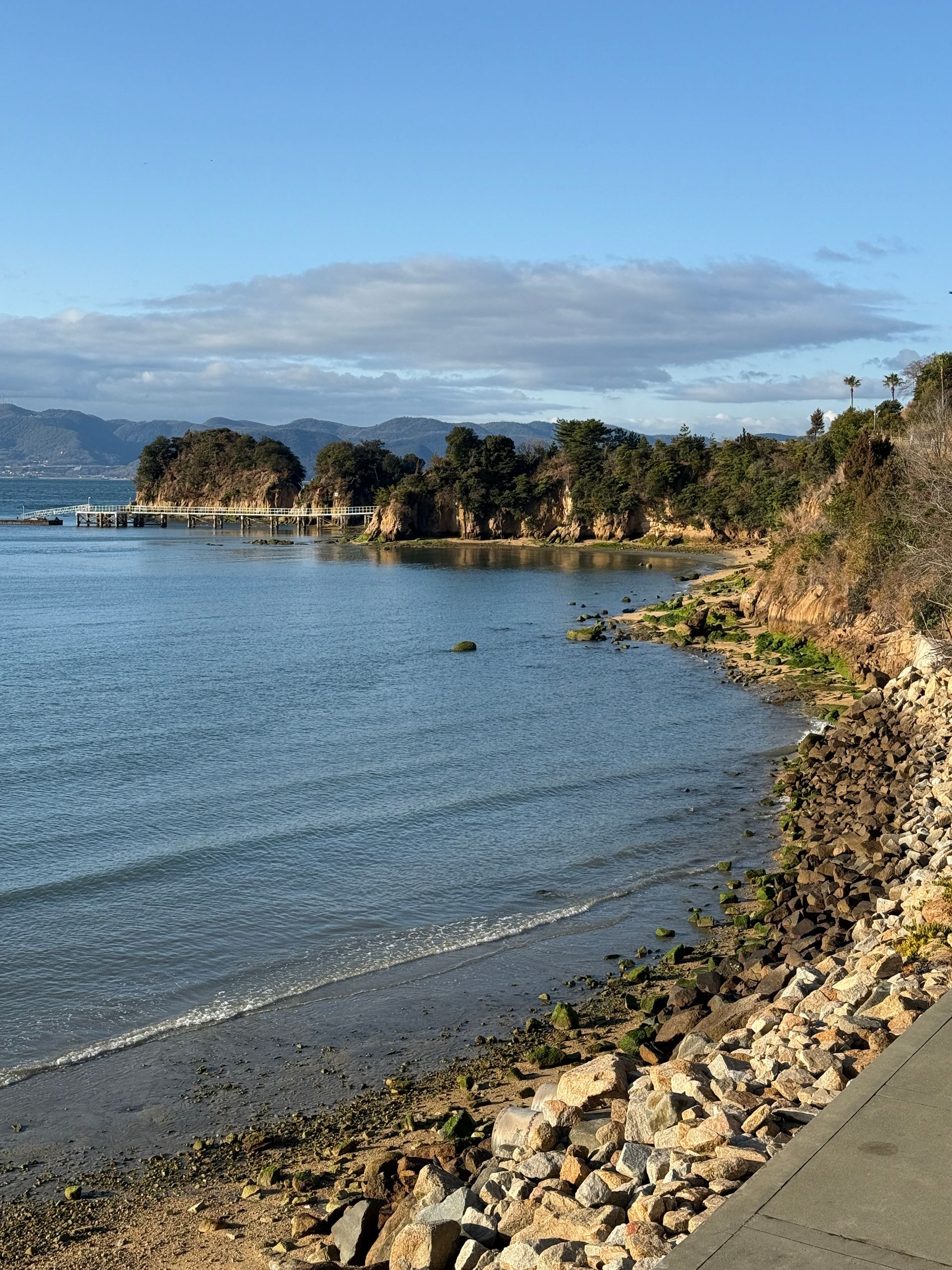
Naoshima lies in the Seto Inland Sea, in Kagawa Prefecture, and until recently it consisted of just a few fishing villages. The island covers 14 km²—roughly the size of Świętochłowice, Poland’s smallest county-level city.
The southern part of the island has belonged since 1987 to Benesse Holdings (formerly Fukutake Publishing), one of Japan’s largest family-owned corporations. “Benesse” means “living well” and is a Japanese neologism with Latin roots, coined by Soichiro Fukutake.
For over three decades, Soichiro Fukutake, the company’s current head, has been pursuing a vision of revitalization through culture. The idea itself isn’t new, but what sets Naoshima apart is its scale, precision, and focus on transcendent art.
To realize the project, they invited a figure with a nearly cinematic biography: Tadao Ando, a self-taught architect and former professional boxer. Raised by his great-grandmother in Osaka, he fought more than 20 matches in his youth. After sparring with more experienced fighters, including Fighting Harada, he abandoned a sports career.
He was fascinated by architecture, but instead of formal education he chose rigorous self-study. In his early twenties, he spent all his savings on a journey along the Trans-Siberian Railway to Europe, just to see Le Corbusier’s modernist architecture with his own eyes.
On Naoshima, Ando perfected his signature “concrete as smooth as silk.” It’s not just a building material but a precisely cast structure, where the formwork module references the dimensions of tatami mats, giving the walls an almost mathematical rigor. The characteristic tie-hole marks are spaced at perfect intervals, forming a rhythmic grid across the façades.
In the 1990s, already a Pritzker Prize laureate (1995), he designed the Benesse House Museum (opened in 1992) and later the underground Chichu Art Museum (2004), demonstrating that architecture can be almost “invisible”—embedded in the topography so as not to disturb the horizon of the Seto Inland Sea.
Today’s Naoshima is a landscape of purity and austerity. This architecture of humility seeks not to disrupt perception but to calm it. The outside world becomes merely a backdrop for experiencing art - a canvas on which each visitor observes their own perceptual encounter with the surroundings.
Ando’s architecture functions not as decoration, but as an “optical processor,” preparing the viewer’s mind for the encounter with the work.


If Ando can be called the creator of Naoshima’s skeleton - its topography—then James Turrell (b. 1943) shaped its soul. The American artist studied perceptual psychology, mathematics, geology, and astronomy, and in most of his works you can feel all of these disciplines at play.
Since the 1960s, he has been a leading figure of the Light and Space movement. He creates installations in which light ceases to be a tool of illumination and becomes the artwork itself: a material, almost tangible substance.
For those who, after Backside of the Moon, want to see more of Turrell’s light installations, the destination should be the Chichu Art Museum. Getting there from Honmura takes about 40 minutes on foot through open, hilly terrain designed by Ando, or 10 minutes by bus or car.
Given the strict reservation system on Naoshima, it’s worth building in a time buffer. Being late usually means losing your entry slot, as groups enter at fixed intervals. The “line for transcendence” does not forgive logistical mistakes. Some might see in this the paradox of Naoshima: that a transcendent experience is, in fact, the product of a highly efficient Japanese economic and logistical machine.
The Chichu Art Museum is located entirely underground, embedded in a hillside and almost invisible from the outside. Inside are several concrete rooms with geometric forms, designed not as neutral white boxes for displaying art, but as spaces that enter into an active dialogue with each of the three permanent collections: Turrell, Walter De Maria, and Claude Monet. All of them engage with light and human perception.
Turrell works with pure light - ephemeral and immaterial. At Chichu, I saw three of his installations that trace his artistic evolution: from optical illusion (Afrum Pale Blue, 1968), through immersion (Open Field, 2000), to a confrontation with the cosmos (Open Sky, 2004).
In the neighboring room stands Walter De Maria’s monumental installation Time/Timeless/No Time (2004). It gives the space weight and physical presence, compelling analytical thought.
And yet, the beginning of it all were Claude Monet’s Water Lilies.
The Chichu Art Museum was created for a single painting. Soichiro Fukutake acquired Water-Lily Pond, a canvas measuring 2 by 6 meters, and realized it could not simply be hung on a wall.
Instead, he commissioned a museum - one that now houses five works from Claude Monet’s Water Lilies series. Here, art is not just an exhibit, but the very reason the building exists.
In designing the gallery, Tadao Ando drew on Monet’s own idea. Toward the end of his life, the painter created a series of monumental water lily paintings intended for the oval rooms of Paris’s Orangerie. He was not interested in paintings hung on walls, but in creating a unity of image, light, and space.
Ando translated this principle underground. In the Monet room at Chichu, there is not a single light bulb. Light enters from above through an opening in the ceiling, while the floor is covered with seven hundred thousand small blocks of white Carrara marble, laid by hand, one by one. The marble reflects and diffuses the light throughout the space, transforming everything.
In the morning, the painting looks different than it does in the afternoon. In winter, different than in summer.
Time/Timeless/No Time is the final part of a trilogy De Maria developed over four decades: from 4–6–8 Series (1966), through 5–7–9 Series (1992), to the concluding 3–4–5 Series (2004), which can be seen at the Chichu Art Museum.
At its center, a granite sphere over two meters in diameter and weighing 17 tons rests in the middle of a vast hall aligned along an east–west axis, surrounded by gilded beams. Instead of screens, projectors, or electronic devices—so often used by Turrell - the true actor in this work is sunlight entering through an open ceiling. As the sun moves, reflections shift across Ando’s raw concrete, altering not only the color temperature but also the dynamics of shadows throughout the space.
Yet light is only the sensory layer. Beneath it lies something colder and more rigorous: a mathematical system that captivated me.
Imagine twenty-seven identical golden columns arranged in rows on platforms within the gallery. Each has the same height and the same smooth, gilded surface; they differ only in their base: one group stands on triangles, another on squares, a third on pentagons.
But that’s not all. The columns are always arranged in groups of three, and within each group, order matters. Triangle–square–pentagon is different from square–triangle–pentagon. De Maria calculated all possible permutations of the three shapes—exactly 27 - and realized every single one. Not one more, not one less. The set is closed and complete.
Yet the choice of forms is not purely mathematical - it is cosmological. De Maria believed that simple geometric forms contain “all the right information about the universe, ourselves, and time.” Curator Massimiliano Gioni describes his works as “the result of complex calculations forming a self-sufficient system.”
The triangle and the square are figures with rational proportions, describable by simple integers. The regular pentagon is the exception: the ratio of its diagonal to its side equals the golden ratio, φ ≈ 1 + squareroot of 5 over 2 = 1.618… - an irrational number that cannot be expressed as a finite or repeating decimal. De Maria seems to have deliberately introduced an element of irrationality into a closed system—a crack through which infinity enters.
And here the paradox emerges. The combinatorics are finite: twenty-seven objects, three shapes, all permutations exhausted. Yet the human experience of these twenty-seven objects in space is infinite—it changes with every step the viewer takes, with every hour, with every shift of clouds above the open ceiling.
De Maria does not pose a puzzle to be solved. He presents a complete set of rules—and then hands it over to forces beyond his control: light, time, and the human body moving across Ando’s concrete.
Let’s return for a moment to the Benesse House Museum, the first to open on the island in 1992. Today, it houses around thirty works inside and numerous installations outside. Benesse is also a hotel, for those who want to experience part of the collection after sunset.
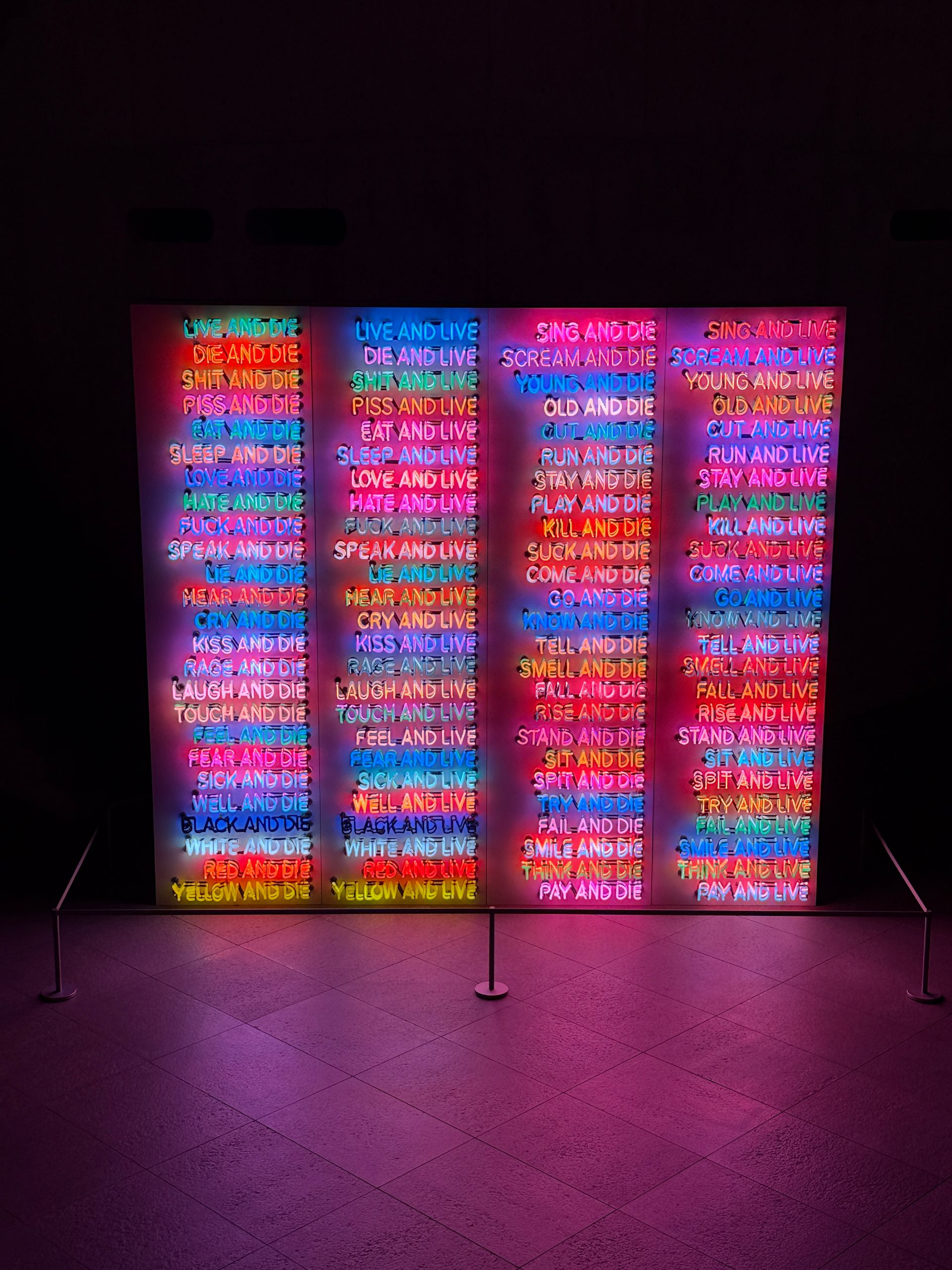
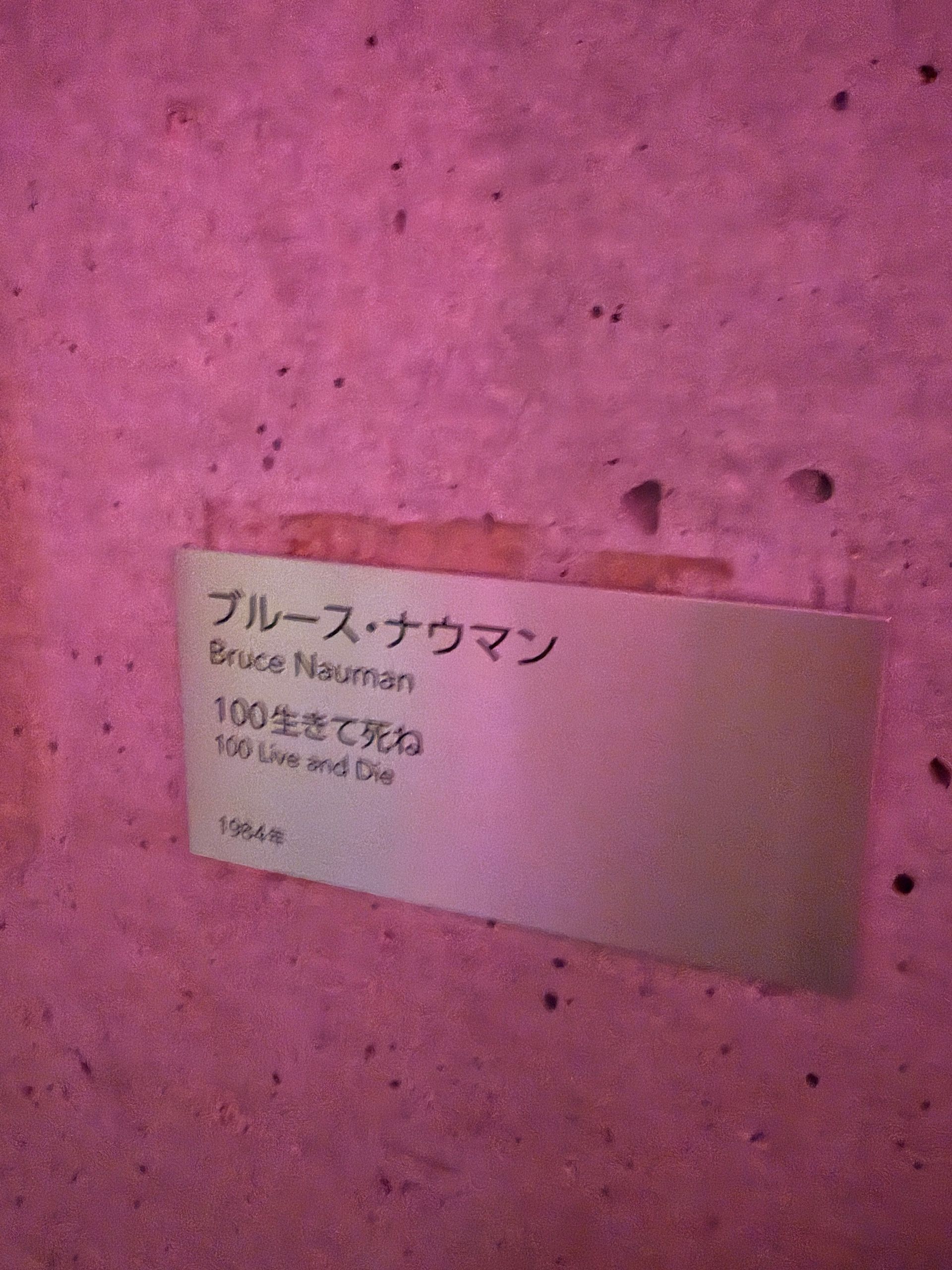
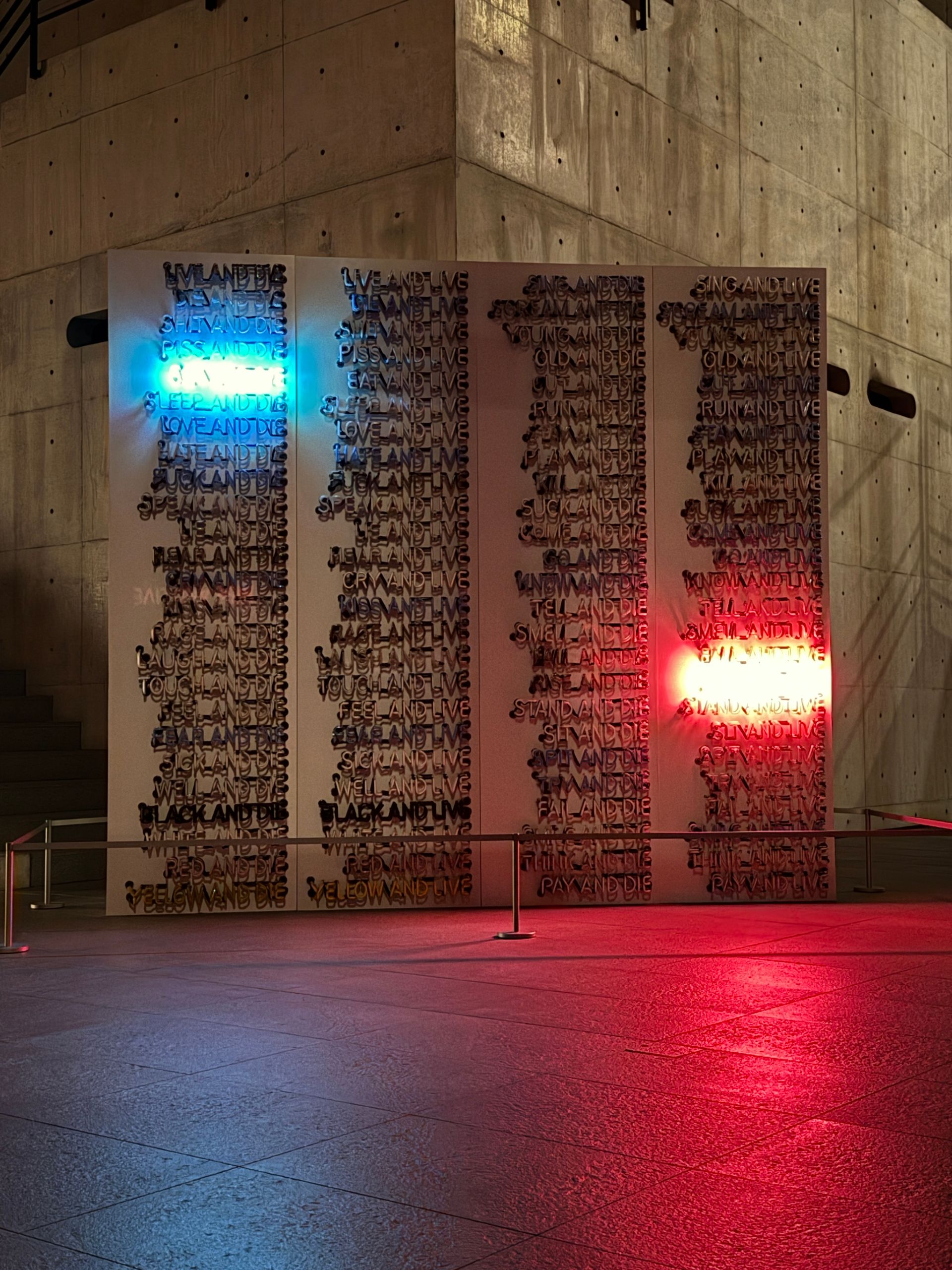
The reception of many works shifts with the time of day. One of the installations that comes alive after dusk is Bruce Nauman’s 100 Live and Die (1984).
The piece occupies a circular concrete rotunda - empty, tall, with a ramp leading upward. On four vertical monoliths, one hundred phrases flicker, all built on the same structure: a verb and live, the same verb and die.
Run and live. Run and die. Lie and live. Lie and die. Kill and live…
The phrases light up and fade out—first individually, then in groups, and finally all at once—flooding the space with pulsating blue, orange, and white light.
Joseph Campbell wrote that human experience stretches between extremes: life and death, good and evil, being and non-being, what endures and what passes. This dualistic thinking is especially reflected in Western culture and ethics, rooted in the biblical exile from Eden and the apple from the tree of the knowledge of good and evil.
Eastern traditions - Hinduism, Buddhism, Taoism, Zen - chose a different path. Yin and yang do not oppose each other but interpenetrate. Nirvana is not the opposite of samsara, but another way of understanding it. Enlightenment is not about choosing the better side, but about awakening beyond the field of choice.
Nauman, an artist from California, constructed a work that expresses precisely this tension in the language of neon. Lie and live or kill and live are different modes of existence that cannot be interpreted without context. Phrases that sound like a verdict in one arrangement become a description of reality in another.
The rhythmic flickering of the lights does not allow the mind to settle on either side. In the darkness and silence of the rotunda, moving between opposites becomes almost physical. You don’t read the phrases - you react to them.
Two days after running the Tokyo Marathon, “Run and Live” carries a particular resonance for me. Running is a way of life—both literally and metaphorically. David Sinclair, a Harvard geneticist studying aging, argues that physical exertion activates longevity genes called sirtuins: moderate stress—hunger, cold, running—triggers an alarm in the cell, and sirtuins respond by repairing DNA and restoring a more youthful cellular identity.
Sinclair calls this hormesis: a small dose of stress that rejuvenates rather than destroys. But hormesis works like medicine—too little has no effect, too much is harmful. Excessive exertion triggers inflammation that does not subside, and instead of turning back the biological clock, it accelerates it.
Anyone who has run enough marathons feels it in their joints, muscles, and tendons:
Run and live. Run and die.
Naoshima’s evolution into a global center of contemporary art has been a process of carefully designed experiments spanning more than three decades. In 1992, the Benesse House Museum opened; in 1994, the now-iconic yellow pumpkin by Yayoi Kusama appeared on the waterfront—originally a temporary installation, it became a permanent symbol of the island.
Today, it is the most photographed artwork on Naoshima - perhaps also because so many other works resist being photographed at all.
Yayoi Kusama (b. 1929) works primarily in sculpture and installation, but she is also a painter and performer. Like Ando, she is self-taught. Widely regarded as one of Japan’s most important living artists, she is said to be the best-selling artist in the world and the highest-earning living artist overall.
She is also an exceptionally sensitive and fragile person, to the point that she has chosen to live in a psychiatric hospital under medical care. Since childhood, she has experienced hallucinations, most often in the form of fields of dots overwhelming her vision—hence their central place in her work. In Kusama’s world, dots symbolize the infinite universe and the dissolution of the self (so-called self-obliteration). They can be unsettling, obsessive, evoking a fear of being absorbed and overwhelmed.
Pumpkins, by contrast, remind her of her grandfather, who, she recalls, gave her a sense of safety as a child. They evoke stability, security, and control, and have a calming effect on her. In many works, she emphasizes their “humorous” form, their resemblance to the warmth of the human body.
By combining the organic form of the pumpkin with a regular, schematic pattern of dots, Kusama transforms an ordinary vegetable into a metaphysical object—an element of the cosmos.
The yellow pumpkin (Pumpkin, 1994), placed at the end of a concrete pier near Benesse House, was severely damaged by a typhoon in 2021 and reconstructed in 2022, becoming an important moment for the local community. A second - red pumpkin stands at the port, greeting visitors arriving by ferry, a preview of the strangeness of the place.
One of the central challenges of the entire Naoshima project is integration with the local community. Did anyone ask the residents how they wanted to live, or what they were missing? Did they have any real influence over the artistic vision, or was it driven primarily by capital?
Part of the answer is the Art House Project, launched in 1998 in the village of Honmura as another stage of Soichiro Fukutake and Tadao Ando’s vision. In this project, Benesse Art Site transforms abandoned houses into immersive works of contemporary art, weaving in the history and memories of former residents.
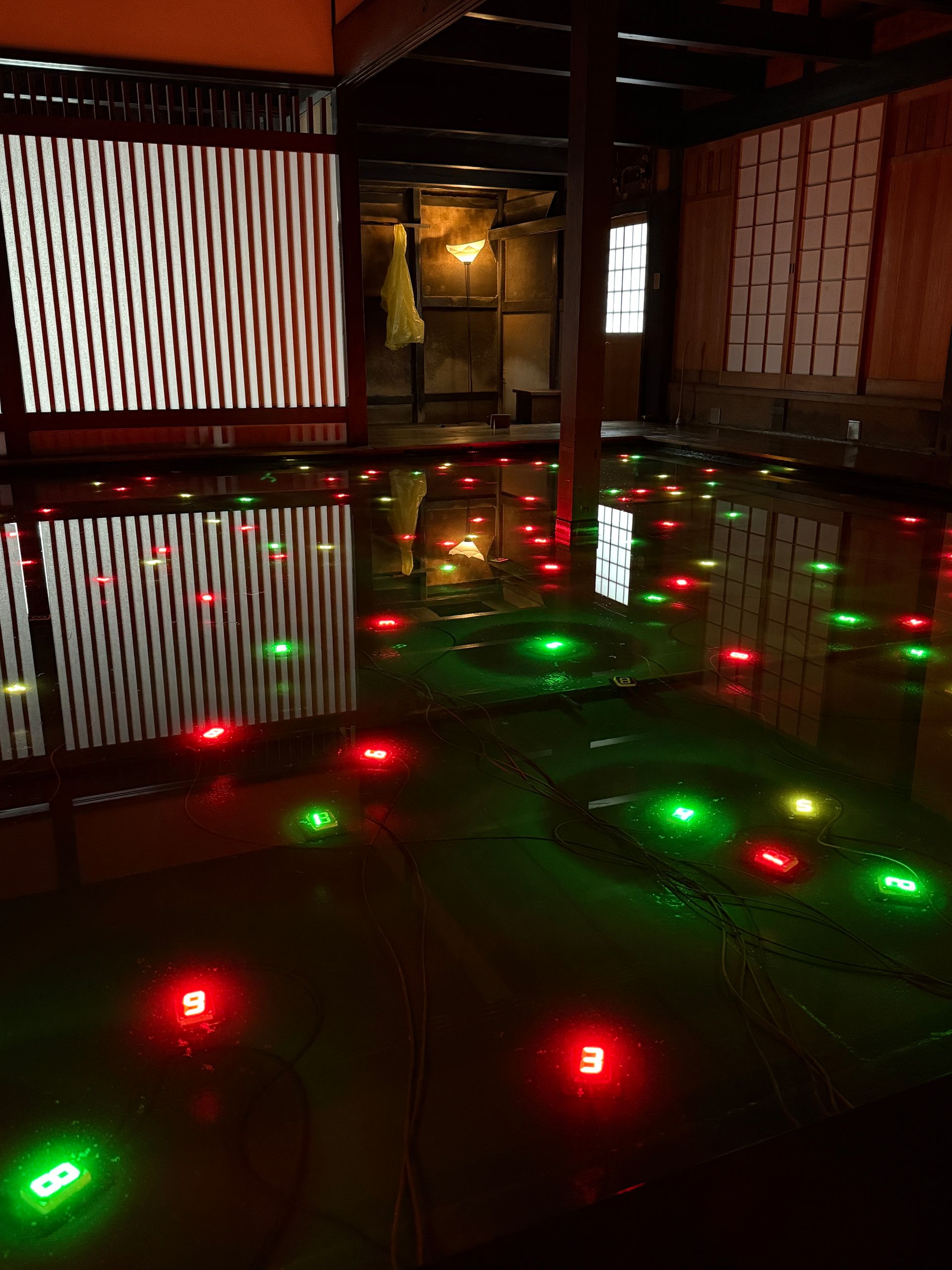
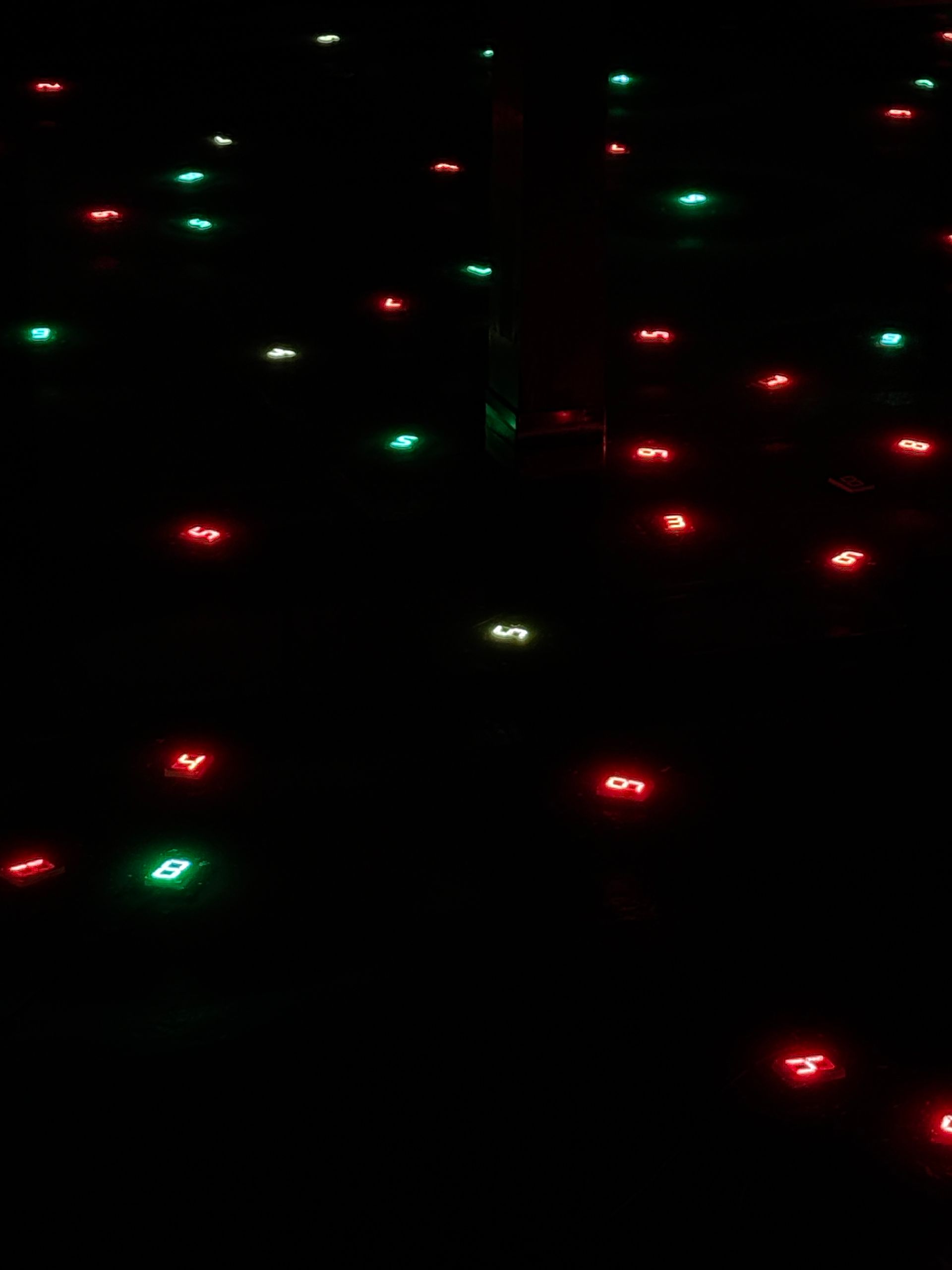
This is where Minamidera is located - the key Ando–Turrell collaboration where I “saw” Backside of the Moon. In another house, Kadoya, one of the first to be restored as part of the project, Tatsuo Miyajima created, together with the local community, the installation Sea of Time ’98 (1998).
In a darkened interior, within shallow pools of water, 125 LED counters are placed—each displaying numbers from 1 to 9, skipping zero, and then starting again. The flickering light in the darkness resembles a digital heartbeat.
Each counter pulses at a different speed, determined during a “Time Setting Meeting” in February 1998. One hundred and twenty-five island residents, aged 5 to 95, took part. Some counters blink quickly, others very slowly, together forming a symphony of personal rhythms - a visual ecosystem of time, where each life unfolds at its own pace, yet all are submerged in the same dark water.

In response to the ecological requirements of the Seto Inland Sea National Park, Ando’s approach has evolved from above-ground buildings toward structures almost entirely hidden underground. After the Chichu Art Museum (2004), the Lee Ufan Museum followed in 2010.
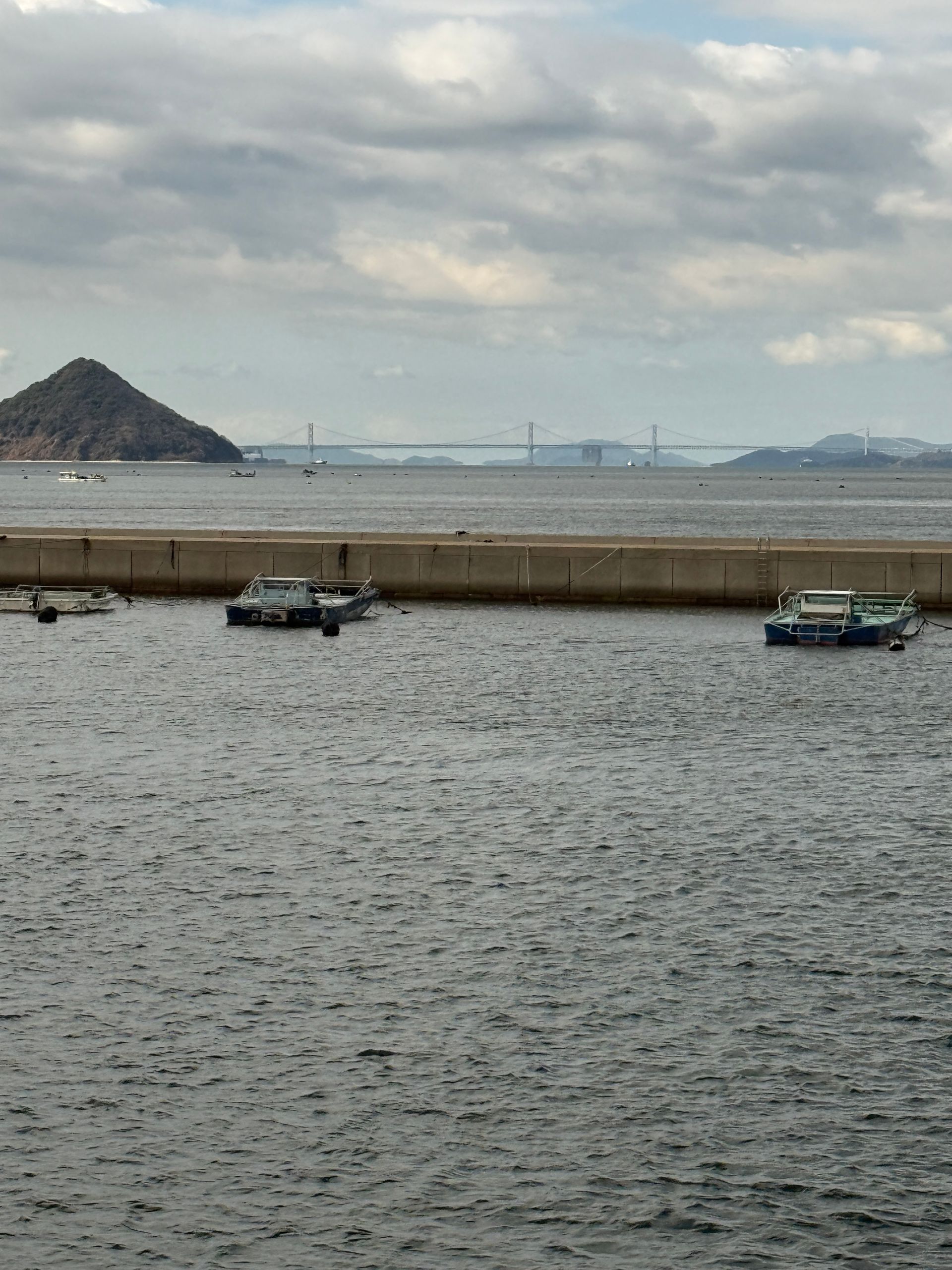
During this time, the Benesse Art Site expanded to neighboring islands - Teshima and Inujima. There, as on Naoshima and in Honmura, art merges with the landscape itself: rice terraces, abandoned houses, sky, and sea.
The latest phase of Benesse’s expansion (2022–2025) includes Valley Gallery, the Hiroshi Sugimoto Gallery, and the Naoshima New Museum of Art—completing an ecosystem in which architecture becomes a tool of perception, and art a mechanism for the region’s survival.
The Naoshima New Museum of Art is the first institution within the Benesse Art Site dedicated exclusively to contemporary Asian art. Ando’s tenth building carries a distinctly different energy from his earlier works. At the heart of the circular structure is a skylight through which natural light flows into the underground galleries arranged across two levels.
The inaugural exhibition, From the Origin to the Future, brings together twelve artists and collectives from Japan, China, Korea, Indonesia, Thailand, the Philippines, and India.
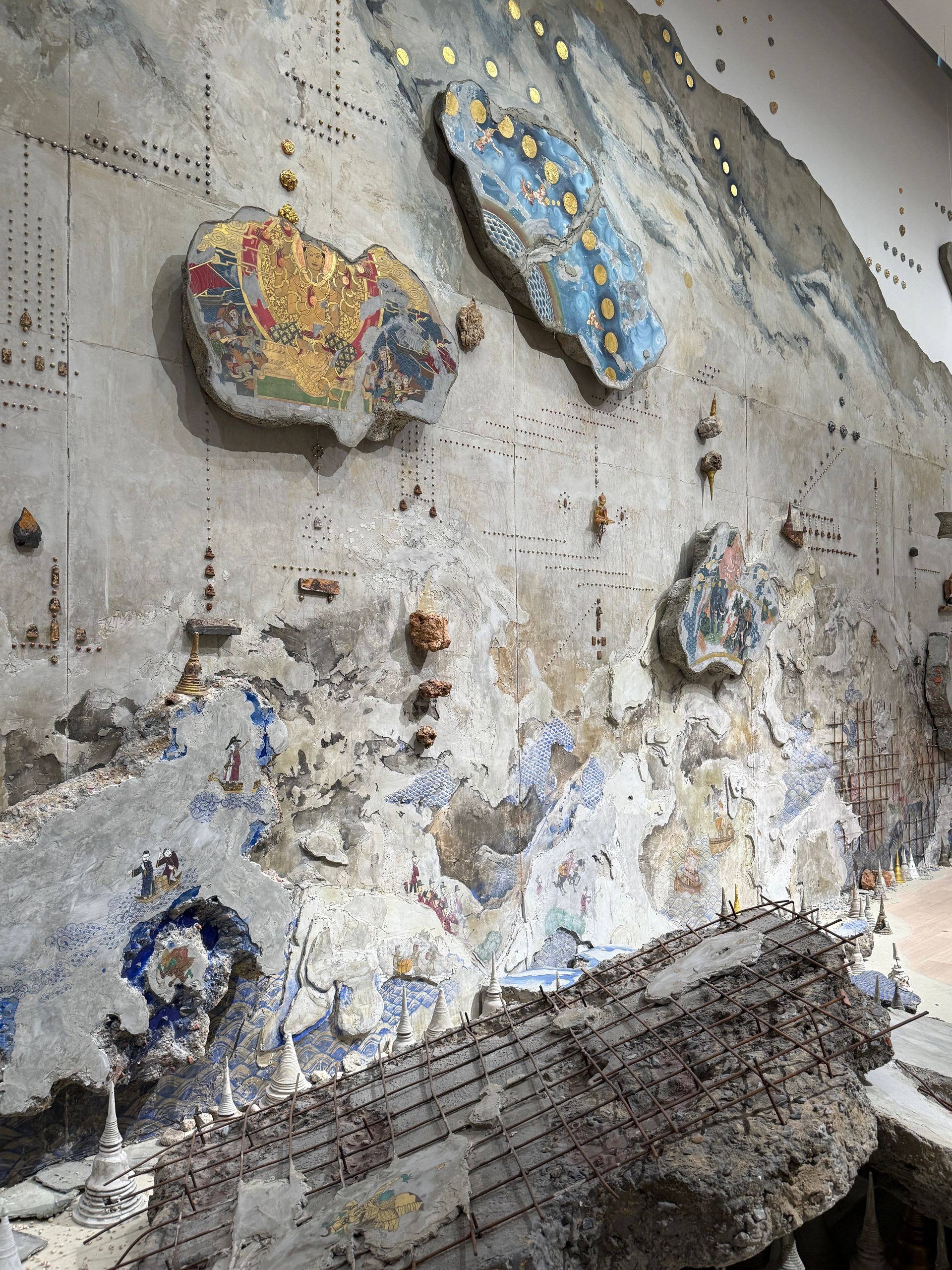
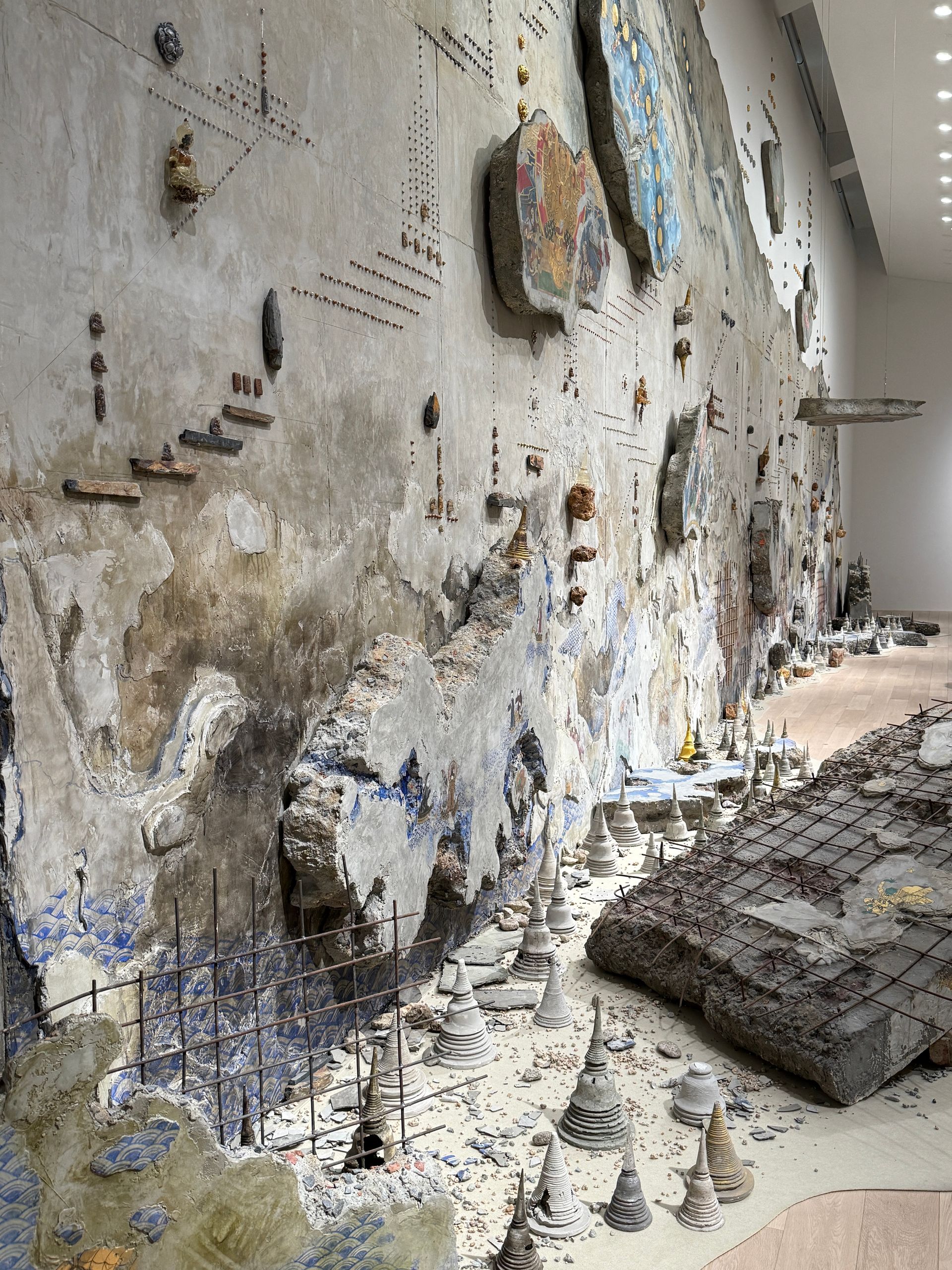
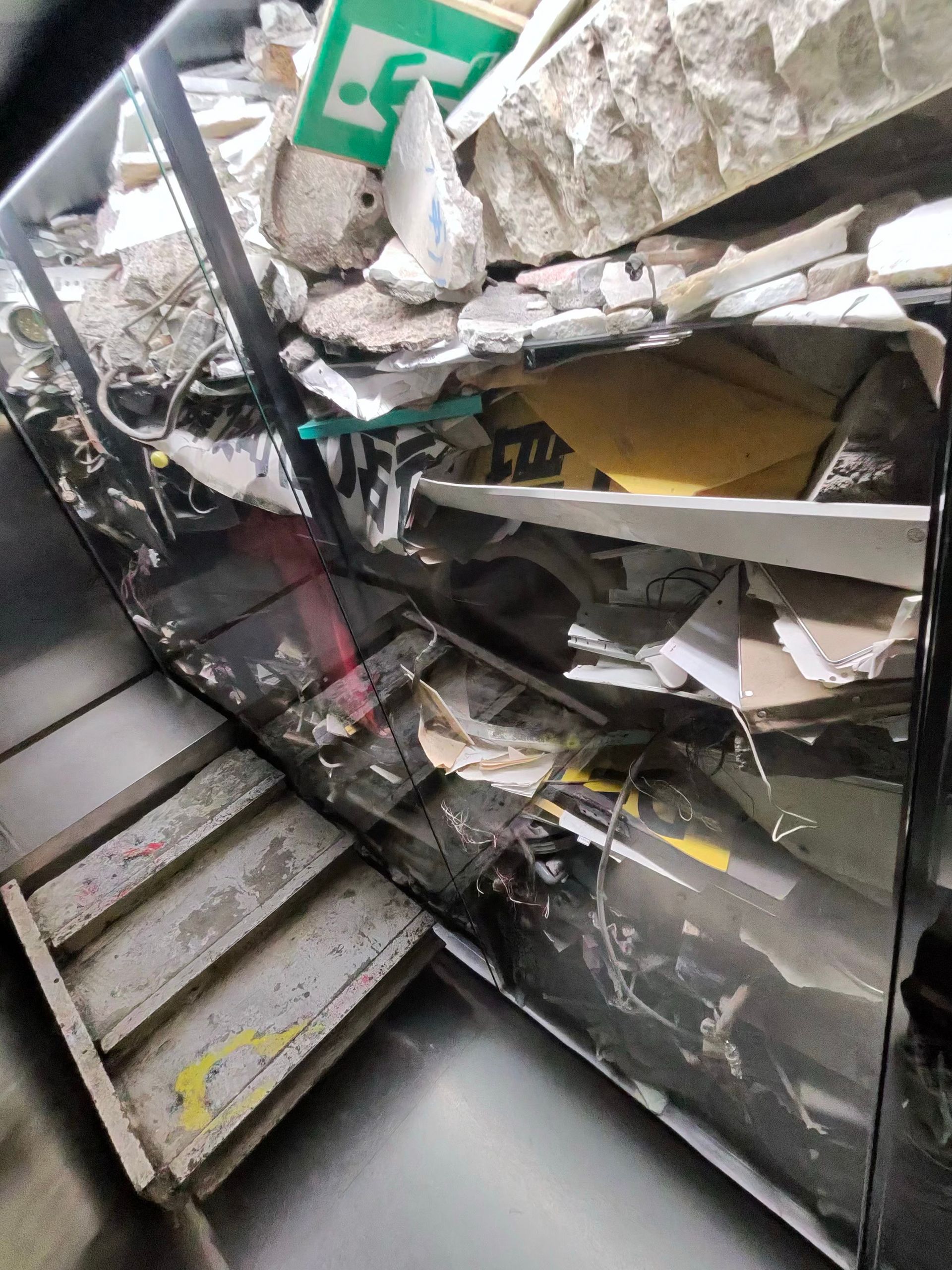
The money behind Naoshima comes from a place not easily associated with transcendence. Benesse Holdings built its position on Shinkenzemi - a subscription-based correspondence education model delivered to millions of Japanese households, fueled by the culture of exam hell, where supplementary learning materials are treated as a basic necessity.
Yet to call Fukutake complicit in that pressure would be like blaming an umbrella manufacturer for the rain. Exam hell existed in Japan long before Benesse. The university entrance exam system took shape during the Meiji era, and the culture of juken (exam preparation) was already deeply ingrained when Soichiro’s father founded the publishing company in 1955.
As one of the few Japanese businessmen of his generation, Soichiro Fukutake chose to invest the profits of that system back into the community.
The financing model he created is based on a simple loop: the corporation builds museums and transfers them to the Fukutake Foundation; the foundation sustains them through dividends from Benesse shares.
By 2020, the family had donated 8% of the company’s shares to the foundation—assets worth around $136 million, generating annual dividends of approximately $3 million. In addition, there are the family’s personal investments: Fukutake estimates that the total cost of building the museums and acquiring artworks has reached about 30 billion yen - roughly $200 million. He adds with a smile that this is “barely the value of one or two average buildings in central Tokyo.” Today, the value of the collection alone is approaching half a billion dollars.
Fukutake calls this “capitalism in the public interest” and articulates a principle that, in a world of quarterly earnings reports, sounds like a manifesto from another era:
“The economy should serve culture. Culture comes first, and the economy should support it.”
Skeptics see in this a sophisticated tax strategy. In Japan, donations of shares to public foundations are exempt from capital gains tax. But reducing four decades of work to accounting overlooks the scale: hundreds of millions of dollars invested in a project with no direct financial return, on an island whose population had been declining year after year.
In recent decades, the foundations of the Fukutake model have begun to show cracks due to demographic change. Shinkenzemi is losing subscribers: in April 2023, enrollment stood at 2.21 million students - 140,000 fewer than the year before. There are simply fewer children in Japan.
In November 2023, the Fukutake family made a bold move: a management buyout supported by BPEA EQT, a Scandinavian-Asian private equity fund. The transaction was valued at 208 billion yen - around $1.37 billion. In May 2024, Benesse was delisted from the Tokyo Stock Exchange.
The arrival of a private equity fund electrified observers. Yet concerns, for now, seem premature. The key museums - Chichu, Lee Ufan, Teshima Art Museum -are owned by the foundation, not the corporation, and were not part of the transaction. Hideaki Fukutake, Soichiro’s son, remains chairman of both Benesse and the foundation, emphasizing that the foundation does not accept external funding in order to preserve the independence of its vision.
The Naoshima New Museum of Art - the most expensive project in the island’s history—opened in May 2025, a year after the deal closed, as planned. EQT did not come to cut spending on museums, but to restructure the shrinking education business and expand the nursing home sector.
The results of four decades are measurable. The island, which had more than seven thousand residents in the 1950s and was steadily depopulating, welcomed over half a million visitors in 2023 - a figure many times larger than its local population. Property prices have risen, young artists rent homes, abandoned machiya have become works of art instead of decaying structures. Older residents, according to Fukutake, have “felt a new sense of life.”
Tourism researchers cite Naoshima as a positive model in which the community feels like a participant, not a victim, of change. Residents say they “wholeheartedly encourage” visitors to come and are happy to share stories about the island over an evening beer. At the same time, the local community undoubtedly requires care and protection to preserve its sense of cohesion and comfort.
I don’t know another place in the world where private capital, architecture, and contemporary art have managed to halt the degradation of a local community and environment in quite this way.
Bilbao in the Basque Country was revitalized through the construction of the Guggenheim Museum, but it was backed by public funding from regional government and European institutions. Inhotim, a private museum in the Brazilian jungle, was built by Bernardo Paz, a billionaire who made his fortune in iron ore mining. Saadiyat, the cultural island in Abu Dhabi, is financed by the emirate’s oil wealth.
Naoshima, by contrast, is the project of one family, one architect, and four decades of patience. “What fascinates me is that these ten buildings were not created according to any top-down master plan. They evolved organically and slowly, like living organisms,” says Tadao Ando.
Some argue that Naoshima is a kind of Disneyland for the elite. But the alternative was a scrapyard. Before Fukutake, the island had endured decades of industrial degradation. A Mitsubishi copper smelter operating since 1917 on the island’s northern tip polluted the air and soil before cleaner technologies were introduced. Nearby Teshima became a “garbage island” - a dumping ground for 900,000 tons of illegally discarded toxic waste, one of the largest environmental scandals in Japan’s history. Young people were leaving all these islands by ferry and not coming back.
Without Fukutake, Naoshima would likely have joined the hundreds of Japanese islands no one writes about -places where the last residents close the final school, and abandoned homes decay among rust and weeds.
Every model has its flaws. But a future with half a million visitors, with Turrell and Monet underground, with Nauman’s neon pulsing in the dark, with Kusama’s pumpkins by the sea, is—on balance—better than a future with no future at all.
And it is absolutely worth seeing.